
By Antonio Hill
Almost every retirement plan has a floor. The number you refuse to drop below. Almost none of them have a ceiling, and that missing number is the expensive one.
So here is my answer on whether you should spend down your principal in retirement. Yes, and you should decide in advance how much you are willing to die with. Here are the two numbers that make the case, both run on a couple spending $120,000 a year and retiring at 40.
Refusing to ever touch your principal costs you 8.7% of your retirement number. Building a serious late life safety floor costs you 2%. Those are wildly different decisions and the personal finance world treats them as the same one.
Build the floor. Set a ceiling. Spend everything in between.
Set a Ceiling on What You Die With
The rule you inherited is never touch the principal. Live on the income, leave the pile alone, sleep well. Sam Dogen at Financial Samurai puts it about as plainly as anyone, arguing the ideal withdrawal rate does not touch principal at all and calling it “how the stealthy wealthy manage their money.”
That rule solves a problem you do not have. Preserving principal forever is what you do when the money has to outlive you by an unknown margin and you have no way to model it. Reasonable for a 70 year old. Strange for a 40 year old with a spreadsheet and fifty years of runway.
I grew up in Biloxi watching my parents live paycheck to paycheck. When I was 17 and started looking at colleges, we sat down to talk about how to pay for it, and the answer turned out to be that nobody had put anything aside. Not a little. Nothing. I got a full ride and it worked out fine. But I walked out of that conversation knowing two things: I was never going to inherit a dollar, and I was going to have to build the whole thing myself.
That turned me into a hoarder, at first. Every dollar felt like the one I might need later, so it sat there. I was not investing it. I was guarding it, and guarding money is a full time job that pays nothing.
Somewhere in my late twenties that flipped. It stopped being about not losing money and started being about what each dollar was actually doing for me. Every dollar needs a job. Some go into the market, some go into a trip my family will remember, and the ones doing neither are the ones costing me something. A pile sitting there doing nothing is not safety. It is just a pile.
So my plan has a target band for what is left when I am done. A floor, because late life gets expensive in ways nothing else does. And a ceiling, because finishing with $2.5 million means I worked years I did not have to and skipped trips I could have taken.
Dying with far more than you planned is not a bonus round. It is a planning error that will most likely land in someone else’s account.
The Ceiling. Most retirement plans set a lower bound and stop. Add an upper one. Pick the range you intend to leave behind, and treat the top of that range as a failure condition, exactly the way you already treat the bottom.
What Preserving Your Principal Actually Costs You
Here is where most people expect a huge number, and here is why they are wrong.
Take a couple spending $120,000 a year, retiring at 40, planning through 90. Assume a 5% real return, meaning after inflation, with spending that keeps up with inflation the whole way. Never touching the principal needs about $2,520,000. Planning to spend it to zero needs about $2,300,247.
That is 8.7% less. Not half. Not a third. Under nine percent.
And that number moves with the length of your retirement, in the opposite direction most of the FIRE internet would guess.
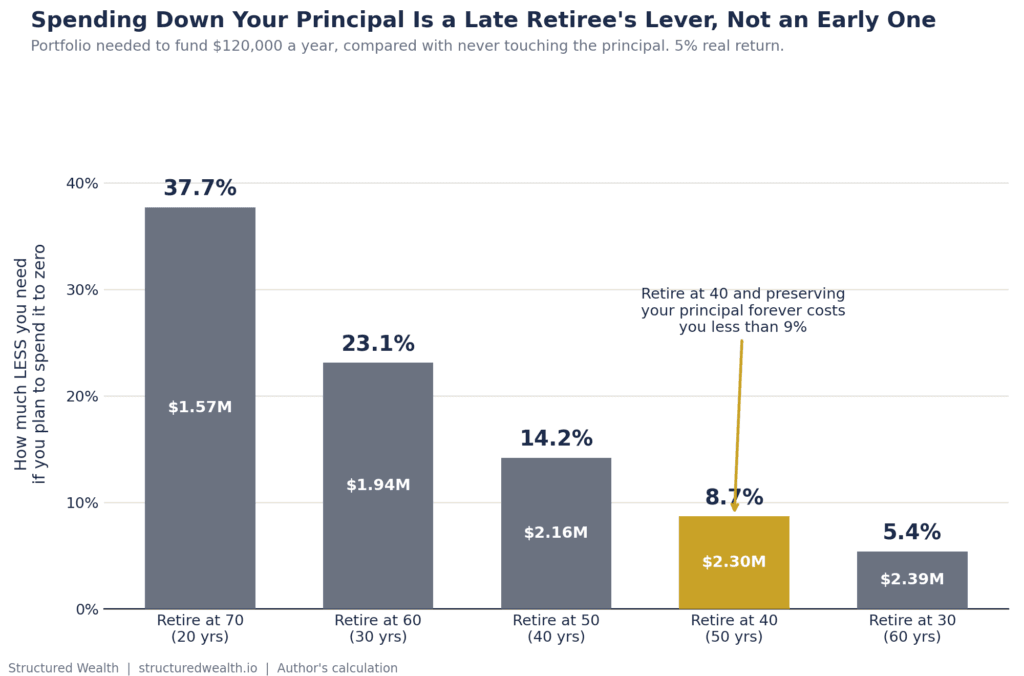
Spending down your principal is a late retiree’s lever. The shorter the retirement, the more of the pile you actually get to consume instead of leaving it to compound. Stretch the same plan across fifty years and compounding does nearly all the work on its own, so the decision to eventually spend the principal barely moves what you need on day one.
Which means if you are chasing spend down as an accumulation lever, retiring at 40, you are pulling on the weakest one available. Flexible withdrawals move your number more. A little earned income in the first decade moves it more. Spend down is worth roughly one to three years of saving, not nine.
So why do I still say plan to spend it down? Because it still decreases my FI number, and also because the number was never really the point.
It is permission. It is the difference between a fifty year retirement where you take the trip and one where you watch the balance climb and tell yourself next year. My daughter is two and a half. The years where she actually wants to go somewhere with her parents are a fixed number and the clock is already running on them. Travel and experiences are the one line item I will never sit around second guessing, and every dollar I refuse to touch on principle is a dollar that never turns into one of those.
The cost of preserving principal does not show up as extra working years. It shows up as money that leaves your life unspent while you are still healthy enough to use it.
Before you touch your own number, grab the free guide, 10 Quiet Mistakes That Kill Your Early Retirement. A retirement number that is too high is mistake number four. The other nine are the same species, quiet enough that you feel responsible the entire time they cost you years.
The Floor Is Cheap. Build It Properly.
The best argument for holding money back is not inheritance. It is the last five years of your life, and most people size that floor by picking a number that feels responsible instead of pricing the actual risk.
So price it. CareScout’s 2025 Cost of Care Survey puts the median private room in a nursing home at $355 a day, or $129,575 a year. A $300,000 floor, the kind of round number people land on, buys about two years and four months of that at today’s prices, decades before you would need it, in a category that has been inflating faster than almost everything else.
How much care are we actually talking about? Research from the Department of Health and Human Services found that 70% of adults who survive to 65 develop severe long term care needs before they die, though only 48% ever receive paid care and most paid episodes run short. Only 24% receive more than two years of it. But roughly one in five people who need care will need it for longer than five years, and that tail is the entire reason a floor exists. The median case does not bankrupt anybody. The tail case does.
So my floor is $600,000 in today’s money. Roughly four and a half years of private room care at 2025 prices for one of us, with room for the other.
Now the number that makes this easy. Going from ending at zero to ending at $600,000 raises what I need at 40 from $2,300,247 to $2,352,569. That is $52,322. About two percent of the target. Call it eight months of saving.
| Plan for the end | Portfolio needed at 40 | Cost vs. spending to zero |
|---|---|---|
| Spend it to zero | $2,300,247 | Baseline |
| End with a $600,000 floor | $2,352,569 | $52,322 (2.1%) |
| Never touch the principal | $2,520,000 | $219,753 (8.7%) |
Read those two rows next to each other, because that is the whole argument. Buy the floor. It barely registers. Then stop, because every dollar above it is an unplanned inheritance you paid for with your own working years.
Somebody always asks about the kids here, so let me answer it straight. I want to leave my daughter as little as possible while never having to worry about money myself. If I’m as good a parent as I aspire to be, she will have built her own half a million (and way more) long before I ever die. The money I might leave will land on top of a pile she already made. What I am actually handing her is the part that took me a decade to work out alone, because nobody in my house knew it well enough to teach me. She is two and a half and I can already tell she is going to be sharper than I was. If she gets this stuff at 22 instead of 32, an inheritance will be the least useful thing I ever gave her.
Almost Nobody Who Plans to Spend Down Actually Does
Here is why the ceiling matters more than the theory. Intending to spend your principal and actually spending it are different activities.
Michael Kitces ran the arithmetic on a retiree with a $1,000,000 portfolio who deliberately plans to spend it to zero over thirty years. Even with that as the stated goal, at 8% returns and 3% inflation, the balance does not dip into principal until year 17 of 30. Seventeen years of watching the number climb while telling yourself you are spending it down.
Then look at what people do. The Employee Benefit Research Institute published new work in April 2026 tracking retirees through 21 to 22 years of retirement. For households that entered with more than $500,000, median assets fell 42% over those two decades. That is real decumulation and I am not going to pretend otherwise.
But look underneath the median at the spread. Forty two percent of that high asset group still held 80% or more of what they started with after twenty two years. Thirty one percent held 100% or more. Almost a third of well funded retirees finished two decades of retirement richer than they began. EBRI senior research associate Leslie Muller described drawdown as far more complex than a simple spend down pattern, which is a polite way of saying a lot of people never got around to it.
One honest caveat, because it cuts against me. That cohort had pensions. EBRI says so directly and points out that future retirees will not have the same access to guaranteed income. A pension is a floor you never had to build, and it makes leaving the portfolio alone much easier. You and I do not get one. That is an argument for building a real floor, which is exactly what the $600,000 is. It is not an argument for preserving everything.
The pattern holds either way. Give a lifelong saver a portfolio and no ceiling, and a large share of them will die richer than they retired. Not because it was optimal. Because nobody ever told them what the target was.
How to Spend Down Without Panicking
Knowing the math and holding your nerve at 52 while the balance drops are different skills. Three things make it survivable.
Make Your Alarm Schedule Relative, Not Absolute
The instinct is to pick a floor number and watch it. A million dollars, say. Drop below that and something has gone wrong.
Run that against a real plan and it falls apart immediately. My taxable bridge account needs at least $1.65 million at 40 to reach 59.5, when the retirement accounts open, and I’m targeting $1.9 million so that one bad decade doesn’t end the plan. The schedule below runs the bare minimum path on purpose, because the minimum is the one worth setting an alarm against. Spending $120,000 a year at a 5% real return, that bridge crosses one million dollars at age 52. Right on schedule. Perfect execution. An absolute alarm would fire in the dead center of the success case.
An account designed to reach zero needs a schedule, not a floor. Build a checkpoint table before you retire. Here is mine.
| Age | Bridge balance if on plan | Share of starting balance |
|---|---|---|
| 40 | $1,650,000 | 100% |
| 45 | $1,409,635 | 85% |
| 50 | $1,102,862 | 67% |
| 55 | $711,332 | 43% |
| 60 | $211,631 | 13% |
A million dollars at 43 is a fire. A million dollars at 52 is a Tuesday. Same number, opposite meanings, and the only thing separating them is the schedule. Print yours and keep it somewhere, because the version of you staring at a red screen in year three is not going to want to sit there and do the math.
Keep a Discretionary Layer Big Enough to Matter
The reason I can plan to spend principal without much anxiety is not courage. It is that a large chunk of our spending is optional.
Travel runs somewhere between $30,000 and $40,000 of the planned budget. Cutting it entirely is a 29% reduction in annual spending. A standard guardrails adjustment asks for a 10% cut when your withdrawal rate breaches the upper band. My discretionary layer is roughly three times what the strategy actually requires. My wife and I have already talked through it, and travel is the first thing that goes.
Would that sting? Absolutely. Sitting on all the free time in the world with nothing to spend is its own particular kind of miserable and I am not going to pretend otherwise. But two lean years while the market comes back beats going back to a desk, and it beats building a plan that needs the market to behave.
That is the real safety margin. Not a bigger portfolio. A budget with an obvious lever in it. If your entire spending plan is mortgage, insurance, and groceries, you cannot run a spend down plan yet, and you should read sequence of returns risk before you read anything else.
Separate the Spending Pool From the Floor
Morningstar’s retirement income researchers arrived somewhere similar from a completely different direction. Their 2024 work introduced a spending and ending ratio to make the tradeoff between lifetime spending and bequests explicit, and one of their suggestions is to simply separate a bequest portfolio from the spendable one at the start of retirement.
Do that and the psychology stops fighting you. The $600,000 sits in its own bucket, untouchable, doing its job. The same logic decides how big your cash buffer should be and which account it belongs in, because a buffer measured against the wrong pile reads as either reckless or excessive. Everything else is spendable, and spending it is the plan working rather than the plan failing.
Whether you touch principal at all is the last of four decisions in the full withdrawal plan. See how it connects to the other three.
Run Your Own Two Numbers This Week
Open the early retirement calculator and run your retirement number three times. Once ending at zero. Once ending at your floor. Once with the portfolio fully intact at the end.
Write down all three. The gap between the first two is what safety costs, and it will be smaller than you expect. The gap between the second and third is what your inherited instinct costs, and it will be bigger.
Then pick your ceiling and write that down too. Whatever you decide, decide it on purpose. The worst outcome here is not spending too much or too little. It is never choosing a target at all, and finding out at 85 that the default you drifted into was the most expensive option on the menu.
Get the 10 quiet mistakes that kill early retirements. An inflated retirement number is one of them. The other nine are the slow leaks that add years to your timeline without ever announcing themselves. Free, straight to your inbox. Send me the guide
Questions People Ask About Spending Down Principal
Should you spend down your principal in retirement?
Yes, above your floor. Preserving principal forever means dying with money you traded working years to build. Set a floor sized against real late life care costs, set a ceiling on what you are willing to leave, then spend everything between them.
How much less do you need if you plan to spend down your principal?
It depends almost entirely on how long the retirement is. Over a 20 year retirement it is around 38% less. Over a 50 year retirement starting at 40, it is about 9%. The longer your horizon, the less the decision buys you, because compounding is already doing most of the work.
Is it safer to just live off dividends and interest?
Safer for the portfolio, not for you. Living on yield alone usually means spending far less than a sustainable withdrawal would allow, and it quietly converts years of your life into an inheritance nobody planned.
How much should I leave for long term care?
Price it rather than guessing. A private nursing home room ran a median $129,575 a year in the 2025 CareScout survey, and about one in five people who need care will need it more than five years. I use $600,000 in today’s money, which covers roughly four and a half years at current prices with room for a spouse.
How do I know if my balance dropping is normal or a problem?
Build a checkpoint table before you retire showing the on plan balance at each age, then compare against the schedule instead of an absolute number. A balance that looks alarming at 43 can be exactly right at 52.
I write about my own strategy and my own plan. The free guide linked above is genuinely free, and it puts you on my email list where I also sell The Early Retirement Blueprint. I am not compensated by any custodian, broker, or insurer mentioned here. I am a mechanical engineer, not a licensed advisor, and this is educational content rather than personalized tax or investment advice. All projections use the stated assumptions and are not predictions.