
By Antonio Hill
I’m leaving at 40, and waiting until 45 would make me almost a million dollars richer. Both of those things are true. A lot of people who write about this pretend only one of them is.
The standard advice comes in two flavors. Work longer because you’ll be safer, which is what your advisor says. The other is push through the fear because one more year is just fear, which is what the early retirement crowd says.
They’re both dodging the same thing. Waiting wins. It wins on every financial measure there is, and it isn’t close. The question was never whether the money argument is right. It’s what you’re willing to pay to lose it.
So here’s the number, and then here’s how you find yours.
The Math Says Wait
Take somebody in the exact spot most of my readers are in. Thirty three years old. A million invested. Sixty thousand a year going in, held flat in today’s dollars. Planning to spend a hundred thousand a year once the paycheck stops.
Everything below runs at 7% real, meaning after inflation. Aswath Damodaran’s dataset at NYU Stern, updated in January 2026, shows a hundred dollars in the S&P 500 at the start of 1928 turning into $1,157,598 by the end of 2025. That’s 10.02% a year, and against roughly 3% inflation it leaves about 6.8% real. So 7% is the full historical average, delivered perfectly, rounded up.
| Path | Balance at 40 | Balance at 45 |
|---|---|---|
| Retire at 40 | $2,125,000 | $2,365,000 |
| Work until 45 | — | $3,325,000 |
Read the top row twice. The person who quits at 40 spends a hundred grand a year for five years and still ends up richer at 45 than they were the day they walked out. That’s what a 4.7% withdrawal rate against a 7% return does. The portfolio grows faster than they can spend it.
And they’re still $960,000 behind.
The number everyone quotes is too big
Almost every version of this article you’ll find compares $2,125,000 at 40 against $3,325,000 at 45 and calls the difference $1.2 million. I was about to write it that way myself.
It’s wrong. Those are balances on two different dates, and the early retiree’s money doesn’t sit still for five years waiting to be measured. Run both to the same birthday and the real gap is $960,000. Twenty percent smaller than the scary version.
If you’re going to argue with the math, argue with the honest version of it.
Two Thirds of It Has Nothing To Do With Your Paycheck
Here’s where it got interesting. That $960,000 splits cleanly into two pieces, and they aren’t the pieces you’d guess.
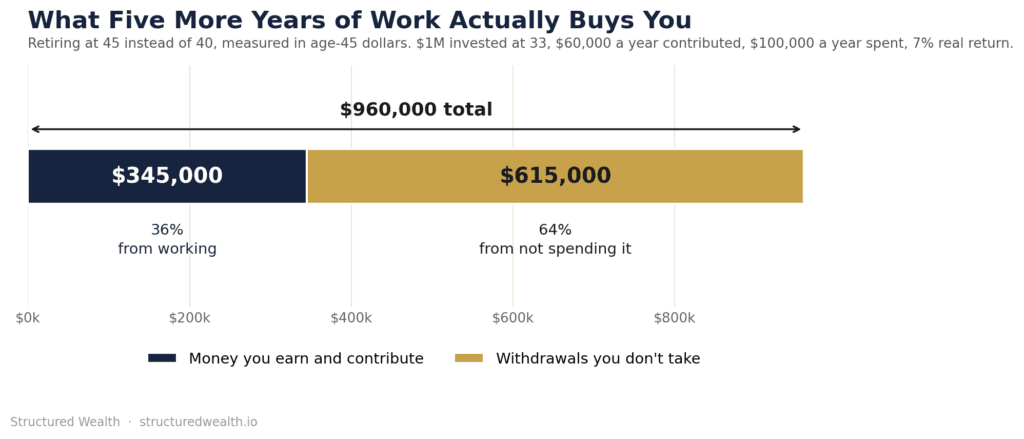
Five years of contributions plus their growth comes to $345,000. Five years of withdrawals you didn’t have to take, plus the growth on money you didn’t spend, comes to $615,000.
Sixty four percent of what working longer buys you has nothing to do with earning anything.
That breaks the strongest argument for waiting. Everybody says the last five years are your peak earning years, biggest salary sitting on top of the biggest balance you’ll ever have, and how could you walk away from that. Turns out your peak earning years are the smaller half. The bigger half is just declining to touch the account.
Which means something useful. Anything that cuts your withdrawals in early retirement captures part of the benefit of working longer without the working longer part. Twenty thousand a year from something you actually want to do. A part time job you actually do for fun, like waiting at a small brewery with a cool vibe, or being a blackjack dealer at a casino back in Biloxi. A year where you underspend because the market got ugly and you paid attention. That’s the same lever, pulled from the other side, and you get to pull it from your couch.
Put A Price On The Years
Once you know waiting wins, the argument stops being financial. So stop having a financial argument about it.
Do this instead. Take what the five years actually pay, $960,000 in age 45 dollars for the person above. Then ask yourself what you’d hand over today, right now, out of the portfolio you already have, to guarantee the earlier date.
Those two numbers are in different currencies, so convert. Money left alone for twelve years at 7% real multiplies by 2.25. Whatever you’d pay today, multiply it by 2.25 and put it next to what waiting pays.
Say the answer is $400,000. That’s $901,000 in age 45 dollars, against $960,000 that waiting would have handed you. Short by about $60,000.
That’s it. Your own price came in under what the years pay. You just proved, with your own number, that this isn’t a money decision. It’s a values decision you’ve been dressing up in an excel sheet, and you should say so out loud instead of running the calculator a fourteenth time hoping it changes its mind. Spoiler alert. It won’t.
My answer, when I made myself sit down and say a number, was $500,000. I’d hand over half a million dollars today to move my date from 45 to 40. When I first said it I told myself that proved I value freedom more than money.
It doesn’t. Run it and it’s basically a tie, and depending on what I assume about my own contributions it can come out either side. I’m not overpaying for freedom. I’m paying roughly what it’s worth and taking it anyway.
That’s a smaller, more honest claim, and I’d rather publish the honest one. If you’ve read what I’ve written about the pretax ceiling, you know I’d rather have the right number than the flattering one.
It also isn’t the only lever. How much of the portfolio sits in bonds going into that window changes what the years are actually worth, and most people get that allocation wrong in the direction that costs them time, not safety.
The Most Famous Regret In Early Retirement Is Actually About A House
Steelman time, and there’s a good one.
Sam Dogen retired at 34 in 2012 and writes Financial Samurai, which is about as established as this genre gets. In a Business Insider essay published in September 2025, he said that if he could talk to his 34 year old self, he’d tell him to “stick it out for another five years”. He figures working through the 2012 to 2017 bull market could have added a million dollars to his investments and $40,000 a year in passive income.
That’s the single strongest piece of evidence against everything I just wrote, from someone who actually lived it. So read what happened.
In 2023, eleven years after retiring, he bought an expensive home he says he didn’t need and went house rich and cash poor. He sold stock and treasury bonds to do it. His passive income fell from around $380,000 to around $230,000. Then he went back to work part time.
That’s not a retirement date problem. That’s a $150,000 a year spending decision made more than a decade later, and it would have hurt just as much if he’d worked until 39. Working five more years would have given him more cushion to absorb it. It also would have given him five more years of the 60 hour weeks he says made it hard to even think about having kids.
He says it himself in the same piece. Poorer for retiring early, richer in the parts that aren’t money.
The lesson isn’t work longer. It’s that the thing most likely to end your early retirement is a purchase you make when you’re 45, and no amount of extra work protects you from your own future self. That’s a spending problem, and I’d rather fix the spending problem.
The One Delay That Actually Buys Something
There’s exactly one condition that would keep me working past 40.
If I hit my number in the middle of a real downturn, I’ll keep working. Not out of fear. Retiring into a crash is the one scenario where the extra year buys something the math genuinely respects. You contribute at low prices, you don’t sell anything at low prices, and you hand the market a year to do what it has always done.
My instinct is to say that all but eliminates sequence of returns risk. That’s too strong, and I checked before writing it.
Sequence risk isn’t a year one, year two, or year three problem. It’s a first decade problem. Michael Kitces found that ten years is the sweet spot, meaning a bad decade at the start of retirement predicts your safe withdrawal rate better than one year does and better than thirty year returns do. Wade Pfau’s 2013 work, cited by MIT Sloan, put roughly 77% of your final outcome on the average return of those first ten years. Morningstar’s 2026 State of Retirement Income research found the retirees who hit bad returns in the first five years and didn’t adjust spending were far likelier to run out.
So working through a crash removes your worst possible starting year. It doesn’t buy immunity, because the bad decade can start in year three whether you’re there for it or not. It’s real, it’s worth doing, and it buys less than it feels like it buys.
That’s why the fix isn’t another year at a desk. It’s spending that can flex and a portfolio built so the first decade doesn’t force you to sell anything you don’t want to sell.
Say Your Number Out Loud This Week
Open whatever tool you use. Mine’s here if you want it. Run your balance to your target date and to five years past it, then run the earlier one forward with your spending coming out, so both land on the same birthday. That difference is your real price tag, and it’ll be smaller than you expected.
Then say what you’d pay today to skip those years. Out loud, to another person, before you do any arithmetic. Multiply it by 2.25 and compare.
Almost everybody’s number lands under what the years pay. Mine did. That’s not a failure of nerve, it’s just what freedom costs, and you don’t get to buy it at a discount because you found a good calculator.
My daughter turns 9 the year I’m planning to leave and 14 if I wait. My dad missed a lot of my basketball games, and he wasn’t a bad father. He was just a tired one who’d been at work. That’s the trade I’m making with a $960,000 price tag stapled to it, and I’d make it again knowing the number is real.
Do you want your freedom or not? Answer that first. The math is downstream.
Five years of work moves your number by about a million. So do about four of the mistakes in the free guide, and those you can fix on a Saturday. Get the 10 Quiet Mistakes That Kill Your Early Retirement, free.
Quick Answers
How much money do you actually lose by retiring five years earlier?
Less than the number usually quoted. For someone with a million invested at 33 contributing $60,000 a year, retiring at 40 instead of 45 costs about $960,000 measured at age 45, not the $1.2 million you get by comparing balances on two different dates. The early retiree’s portfolio keeps compounding while it’s being spent, and that closes about a fifth of the gap on its own.
Is working one more year worth it before early retirement?
Financially, yes, and that’s true of the year after that too, which is the trap. The year is worth it when your number depends on it or when you’d be retiring into the middle of a downturn. It stops being worth it the moment you’ve hit a number you agreed to when you were thinking clearly, buffer included. Not the thirteenth revision of that number.
Why isn’t the cost of retiring earlier a straight line?
Because every extra year does two jobs. It adds a year of contributions and growth, and it removes a year of withdrawals. It also shortens the stretch your bridge account has to cover before 59 and a half. Those stack, which is why the second half of a five year delay looks bigger than the first half.
Should you keep working if you love your job?
You can’t fully love a job your lifestyle depends on. I’d happily play video games all day, but if my daughter’s daycare came out of my ranking, it stops being a game and starts being a job with better scenery. The pressure is the thing that ruins it. Take the pressure off and you might find you like the work more, on your terms, for as long as you want it.
I write about my own strategy and my own plan. The free guide linked above is genuinely free, and it puts you on my email list where I also sell The Early Retirement Blueprint. I am not compensated by any custodian, broker, or insurer mentioned here. I am a mechanical engineer, not a licensed advisor, and this is educational content rather than personalized tax or investment advice. All projections use the stated assumptions and are not predictions.