
Four decisions turn a portfolio into a paycheck that has to last 50 years. Size, rate, defense, order. Run them in that sequence and you just might be able to retire early. Run them in any other sequence and you’ll spend six months perfecting an answer that depends on three numbers you haven’t worked out yet.
Almost every article you’ll find starts at the end. I ran four searches on withdrawal planning while building this page, and three of them handed back the same thing. Sell your taxable brokerage, then your traditional accounts, then your Roth. That’s account order. It’s the fourth decision, and it’s the smallest of the four.
This is the map for the whole pillar. Every article underneath it answers one of these four, and they’re linked in the order you should read them.
The Chain Only Runs One Direction
These four decisions aren’t a menu. They’re a dependency chain.
You can’t pick a withdrawal rate without knowing what you’re spending. You can’t set a portfolio target without a rate. You can’t build defense against a bad decade without knowing what that defense is protecting. And you can’t sequence accounts until you know how much comes out of them each year. Every stage takes the answer from the stage before it as an input.
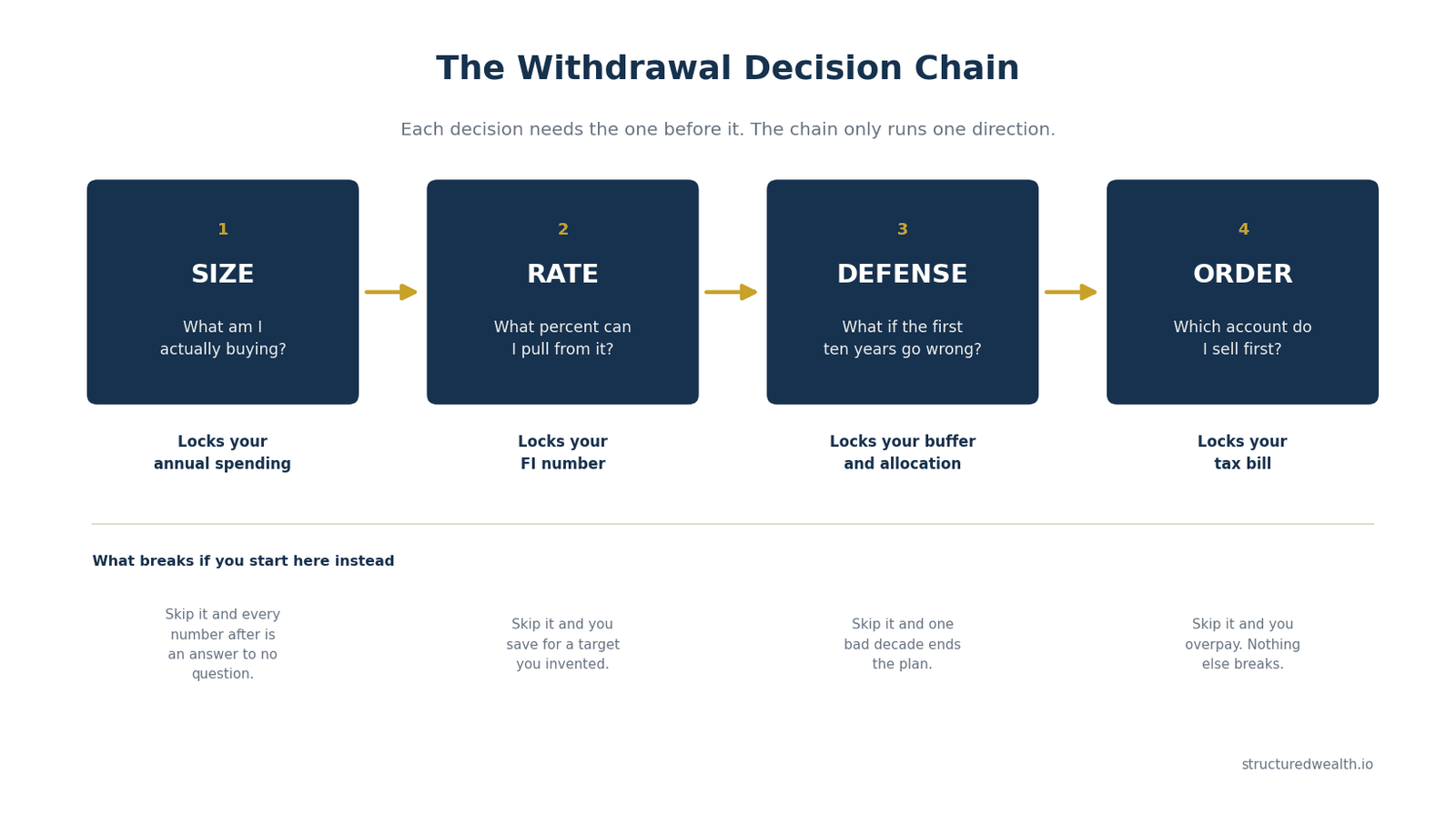
Skip a stage and you don’t get a worse answer. You get an answer to a question you never asked.
Decision One. What Are You Actually Buying?
Retirement isn’t one thing you either can or can’t afford. It’s a spending level you choose, and the level you choose sets everything downstream.
Most people skip straight past this because it feels obvious. It isn’t. The gap between a lean early retirement and a comfortable one isn’t a lifestyle preference you can decide later. It’s 20.5 years of working, according to the model household I ran in the sizing article below. Start here and you’re deciding how much of your life you’re willing to trade. Start anywhere else and you’re optimizing a rounding error.
- What lean, chubby, and fat FIRE actually cost in years of work, which is where you pick the spending level before anything else gets calculated.
- How much you actually need to retire at 40, which turns that spending level into a portfolio target.
Run your own version in the early retirement calculator before you read anything else on this page. Ten minutes. The rest of the chain means very little until you have that first number in front of you.
Most of what wrecks this chain happens years before you get to use it. The withdrawal plan runs on whatever portfolio you hand it, and the portfolio gets built while you’re still working. I put the ten quiet mistakes that add years to a timeline into a free guide, and eight of the ten are accumulation decisions you’re making right now.
Decision Two. What Percent Can You Pull?
Here’s the thing that took me a long time to understand. The safe withdrawal rate isn’t a fact you look up. It’s an output of the spending system you choose, and the range is enormous.
Morningstar publishes this research every year, and their 2025 edition makes the point better than I could. Their base case starting rate is 3.9% for a 30 year retirement at a 90% success rate, drawn from portfolios with “modest equity weightings between 30% and 50%”, with data as of September 30, 2025. Same research shop, same year, same 30 year horizon, but with flexible spending methods layered in, and the number climbs to 5.7%.
| Morningstar 2025 scenario | Starting rate | Portfolio needed at 100k spending |
|---|---|---|
| Base case, 40 year horizon | 3.3% | $3,030,000 |
| Base case, 30 year horizon | 3.9% | $2,564,000 |
| Guardrails, 30 year, 40/60 portfolio | 5.2% | $1,923,000 |
| Best flexible method, 30 year | 5.7% | $1,754,000 |
Look at the middle two rows, because those share a horizon. Same 30 years, same research, and $810,000 of difference in what you need to save. That gap isn’t market luck. It’s whether you’re willing to spend less in a bad year.
I plan on 5%. That’s higher than almost any institution will print, and I’m comfortable with it because I’m not promising to spend the identical inflation adjusted amount in 2041 that I spent in 2040. Rigidity is what makes 4% look generous.
- Why the 4% rule is too conservative and inflates your number, which is the case against treating a 1990s rule of thumb as a law.
- The guardrails withdrawal strategy explained simply, which is the system that earns the higher rate in that table.
Decision Three. What If The First Ten Years Go Wrong?
Now the rate has to survive contact with a market that doesn’t care about your spreadsheet.
Sequence risk is simple to state and brutal in practice. Retire the week before a crash and you’re selling depressed shares to buy groceries, and those shares never come back to participate in the recovery. Wade Pfau put a number on it in The Lifetime Sequence of Returns. He found the compounded return of the first ten years “can actually explain 77% of the final retirement outcome”.
Worth knowing what’s behind that figure before you lean on it. Pfau modeled a 30 year retirement. If you’re leaving at 40 you’re planning for something closer to 50, so the first decade is a smaller slice of your timeline than it was in his model. The direction holds. The exact percentage is his, not yours.
So Why Isn’t Defense First?
Fair question, and it’s the strongest argument against this whole ordering. If the first decade drives most of the outcome, shouldn’t you build the defense before anything else?
No, and the reason is definitely worth discussing. Importance and sequence are different things. A buffer has to be sized against something, and that something is the spending the rate produces. My own cash buffer will keep three years’ spending, and it’s sized against the bridge account, not the whole portfolio. I couldn’t have built that without knowing the bridge number first, and the bridge number came out of the rate, and the rate came out of the spending. Defense probably matters most. It still can’t go first.
- Sequence of returns risk and what it does to an early retirement, which is the risk this whole stage exists to handle.
- How much you should hold in bonds retiring at 40, which sizes the buffer against the right account instead of the whole portfolio.
Decision Four. Which Account Do You Sell First?
Last, and smallest. Which doesn’t mean unimportant.
Getting the size wrong moves your retirement date by years. Getting the order wrong costs you tax efficiency, and over 50 years that’s real money. But it’s recoverable money. You can fix a withdrawal order in January. You can’t fix a spending target you built a decade of savings around.
The conventional order is taxable, then traditional, then Roth. For someone retiring at 40 that advice is often backwards, because it ignores the conversion window sitting between your last paycheck and 59½.
- Which accounts to withdraw from first in early retirement, which is where the standard order breaks for anyone leaving before 59½.
- Whether to spend down your principal or preserve it, which sets the ceiling on the whole drawdown.
One boundary worth naming. This chain assumes you can physically reach the money, and before 59½ that’s a separate problem with its own machinery. If the penalty wall is what’s actually blocking you, start with how early retirees get to locked retirement accounts anyway, then how big your taxable brokerage bridge needs to be. If it’s the tax bill, a retired couple pulling six figures at zero federal tax shows what the ceiling looks like.
Where To Start, Based On Where You Are
You’re Still Working And Years From The Exit
That’s most people reading this, and it’s where I still am. Do stage one and stop. Pick the spending level, get the portfolio target, then go back to your contribution decisions, because those are the only levers you control today. Reading about withdrawal order at 32 is entertainment.
You’re Inside Five Years Of Quitting
Stages one through three, in order, and give stage three the most time. The buffer and the allocation have to be in place before the last paycheck, not after. Also worth knowing whether you’ve built too much pretax, which is a question with a real deadline attached.
The action step. Open a blank page and write four lines. Annual spending. Withdrawal rate. Buffer size and where it sits. Account order. Whichever line you can’t fill in is where the chain breaks, and it’s the only one worth working on this month. Fill them top down. That’s the entire method.
The Portfolio This Plan Runs On Gets Built Now
Every decision on this page operates on a pile of money you’re still accumulating. The withdrawal plan can’t rescue a portfolio that arrived too small or in the wrong accounts. I wrote up the ten quiet mistakes that quietly add years to a timeline, the ones that don’t feel like mistakes while you’re making them.
The portfolio figures in the table are my own arithmetic on Morningstar’s published starting rates at $100,000 of annual spending, and the horizons differ by row, so don’t read them as a single comparison. My own 5% figure is what I plan to use, not a recommendation with a study behind it. The 20.5 year figure in the opening section comes from the model household in the sizing article linked above, not from your own numbers. I sell a paid product called The Early Retirement Blueprint and the free guide above feeds it, so you should know I have a reason to want your email. I’m a mechanical engineer who has done this math on his own money for a decade. I’m not a financial advisor and this isn’t advice for your situation.