
By Antonio Hill
A guy at work found out I plan to retire at 40 and hit me with the “Must be nice. Most of my money’s locked up until 59½.”
No it isn’t. A portion of his money sits in one account with one rule on it. And he let that one rule decide the next 25 years of his life.
That sentence, “my money’s locked until 59½,” is very expensive in personal finance. People say it, believe it, and then work 15 extra years they never had to work.
Eight ways around it exist. If you’re leaving before 45, four of them are noise, and the ranking flips completely at 55. Every key is below, along with which ones are actually yours, the order to build them in, and where the deep version of each one lives.
If the brokerage account is already your biggest account, jump to the Key Ring. Everyone else, top to bottom.
The Money That Was Never Locked
When somebody I know says their money is locked until 59½, my honest reaction is that they’re being dumb right now. Not that they are dumb. They’re just being dumb. There’s a difference, and the difference is information.
The correct sentence is this. “A large portion of my money is locked until 59½, but I have options.”
People think the 401k is THE retirement account. Singular. It’s the one your employer told you about, it’s the one your parents had, and nobody ever encouraged you to learn more. So the whole retirement plan becomes one account with an age gate on it, and the age gate becomes the earliest you can retire.
Any account can be a retirement account. A brokerage account. A Roth IRA. An HSA. Even a savings account, although I wouldn’t advise that one. A retirement account is any pile of money with the job of replacing your paycheck. The tax code doesn’t get to define that for you. You do.
And think about what the default plan asks of you. Your time belongs to you as a kid, when you can’t really make money with it. Then from 22 to 65, most of your waking hours go to making somebody else rich and building THEIR dream. Then you get whatever years are left. We’ve normalized that, and it’s honestly crazy to me.
The government wrote rules on a commonly used type of account. Fine. So we use those rules, all of them, and we ALSO use accounts that have different rules. Four of those accounts have no age gate at all.
The brokerage account is the workhorse
A regular taxable brokerage account has no age gate, no contribution limit, no penalty, and no permission slip. You put money in, it grows, you sell shares whenever you want. This is the bridge account, the pile that carries you from your last paycheck to 59½, and for anyone retiring in their 30s or 40s it’ll do more heavy lifting than every strategy on this page combined.
“But you pay taxes now AND taxes on the gains.” I used to think that too. I thought volunteering for more tax was insane, especially watching what came out of my checks as a single guy earning six figures. Then I ran the numbers.
Long term capital gains get their own tax brackets, and those brackets are absurdly friendly to someone with no paycheck. For 2026, a married couple filing jointly pays 0% federal tax on long term gains as long as taxable income stays under $98,900, per the IRS inflation adjustments in Revenue Procedure 2025-32. Stack the $32,200 standard deduction on top and that couple can realize $131,100 of gains in a year and owe zero federal income tax on them. Zero.
And only the gain portion of each sale counts as income, since part of every withdrawal is just your own money coming back. What fraction that is decides how much you can actually spend inside the 0% band, so it’s worth knowing how much of your taxable account is unrealized gain before you plan around this. Your state may still want a small cut. Mine can have it.
So the “double tax” account is, for an early retiree, frequently a no tax account. Eat the taxes now, within reason. After tax money is not the end of the world.
Roth contributions, the HSA, and the 457(b) cheat code
Three more doors people walk right past.
Your Roth IRA contributions come out anytime. Tax free, penalty free, any age, any reason. The IRS ordering rules pull contributions first, then conversions, then earnings, so your own deposits are never trapped. Earnings stay put until 59½, and every dollar you contributed is accessible the whole time.
So use it. Max the Roth IRA every year, $7,500 for 2026, and automate the contribution in January so it happens before you can overthink it. Why bother when the brokerage already works? Because every dollar of growth in here is tax free for life. The brokerage gets 0% on gains only while your income stays low. The Roth gets nothing at any income. And it’s the one account the government never forces open, since Roth IRAs have no required withdrawals while you’re alive. Flexible on the way out, sheltered the whole way through. No other account gives you both at once.
If you’re a high earner, check the income phase out before contributing directly. For 2026 it runs from $242,000 to $252,000 for joint filers, per IRS Notice 2025-67. Anywhere near that range, or over it, use the backdoor Roth instead. Contribute to a traditional IRA, convert it, done. Backdoor money enters as a conversion, so it rides the same five year clock you’ll meet in the ladder section. Your regular contributions stay accessible immediately.
The HSA is the most tax advantaged account that exists, and not enough people play it right. Money goes in pretax, grows tax free, and comes out tax free for medical expenses. For 2026 the limits are $4,400 self only and $8,750 for family coverage, per IRS Revenue Procedure 2025-19. The early retirement move is this. Pay today’s medical bills out of pocket, save every receipt, and let the HSA ride fully invested. IRS Notice 2004-50 sets no time limit on reimbursing yourself for qualified expenses incurred after the account was opened. A $2,000 receipt from when you’re 30 is a $2,000 tax free withdrawal whenever you want it, even at 45, even after the money spent 15 years compounding. Don’t touch it for anything else before 65, because non medical withdrawals eat income tax plus a 20% penalty. At 65 the penalty disappears and the whole thing behaves like a traditional IRA with a medical bonus attached.
And the 457(b). If you work for a state or local government and have a governmental 457(b), congratulations, you’re playing with cheat codes. Distributions after you separate from service skip the 10% early withdrawal penalty entirely, at any age. Quit at 41, start withdrawals at 41, pay ordinary income tax and nothing else. Most private sector engineers like me don’t get one. If you do, it jumps the line ahead of everything else here.
The Keys to the Locked Box
Now the traditional 401k and IRA money. Pretax, deducted on the way in, guarded by the 10% penalty until 59½. Two keys matter most for anyone leaving in their 30s or 40s.
The Roth conversion ladder
A conversion takes money that has never been taxed, your traditional 401k or IRA balance, taxes it right now at your current rate, and moves it into a Roth where it’s never taxed again. The entire game is choosing WHEN “right now” happens. Convert while you’re working and you pay your peak rate. Convert after you retire, when your paycheck is gone and your bridge account is covering life at 0% capital gains rates, and that conversion lands in the 10% and 12% brackets. Maybe partly in the 0% standard deduction space. You control when you get taxed and how hard.
The ladder part exists because of one rule. Each conversion has to sit in the Roth for five tax years before you can pull out that converted principal penalty free, and every conversion starts its own five year clock on January 1 of its year. So you convert a year of living expenses every year, and starting in year six, a seasoned rung comes due annually. Convert at 40, spend it at 45. Convert at 41, spend it at 46. A ladder.
Which means the bridge account isn’t optional. It feeds you through the first five years while the early rungs season. How big does it need to be? Five years of spending is the floor, and the honest answer depends on three things you get to choose.
One more thing nobody tells you before you move. The federal treatment is clean. Your state’s is a separate question, and a handful of states tax a conversion ladder in ways that surprise people. Check yours before you build a plan around a number.
The ladder is my default answer for almost everyone reading this. Flexible, no commitment, sized however you want each year, and it converts peak bracket deductions into low bracket income. That spread is free money for doing paperwork once a year.
The 72(t) escape hatch
The IRS will also just let you take penalty free withdrawals from your IRA at any age, through what’s called a series of substantially equal periodic payments, or SEPP, under section 72(t).
You have more control over the size than I used to think. There are three IRS calculation methods, and since IRS Notice 2022-6 you can assume an interest rate up to 5% or 120% of the federal midterm rate, whichever is greater, which raised the possible payments a lot. Michael Kitces ran the numbers. A 50 year old with $1 million saw the maximum annual payment jump from about $37,000 to over $63,000 under the new floor. You can also split your IRA into two accounts and run the SEPP on just one, sizing the payment to whatever you actually need. And one of the three methods recalculates annually rather than staying identical.
What I had exactly right is the handcuffs. Once it starts, the schedule runs for five years or until 59½, whichever is LONGER. Start at 40 and you’re locked in for nearly two decades. Bust the schedule once, take too much, take too little, stop early, and the IRS claws back the 10% penalty on every withdrawal you ever took under the plan, plus interest. Income changes, family emergency, doesn’t matter. Rob Burnette, an investment adviser representative and tax preparer at Outlook Financial Center, told reporters the rule is “not as simple as expected.” His words for it were blunter than that. “It is very complex.” When the guy who does this for a living says that, believe him.
My take. The 72(t) is a real tool with a narrow lane. If you’re 50 to 55 with most of your wealth stuck in pretax accounts and a thin bridge, it can carry you those last years to 59½, and the lock in period is short enough to live with. At 40, committing to two decades of mandatory withdrawals with a retroactive penalty hanging over every year? No thanks. The ladder does the same job with none of the handcuffs.
| Key | Works at any age | Tax on withdrawal | Flexibility | The catch |
|---|---|---|---|---|
| Brokerage account | Yes | 0 to 20% on gains only | Total | You fund it with after tax dollars |
| Roth contributions | Yes | None | Total | Contributions only, earnings wait |
| HSA with receipts | Yes | None | High | Must have saved receipts, medical amounts only |
| Governmental 457(b) | Yes, after separation | Ordinary income | High | Only some government jobs have one |
| Roth conversion ladder | Yes | Ordinary income at conversion, at your retirement bracket | High | Each rung waits five years |
| 72(t) SEPP | Yes | Ordinary income | Almost none | Locked until 59½, retroactive penalty if busted |
| Rule of 55 | 55 and later | Ordinary income | Medium | Last employer’s plan only |
| Pay the penalty | Yes | Ordinary income plus 10% | Total | You lit 10% on fire |
The Rule of 55 and the Break Glass Options
The Rule of 55 gets a lot of press, so here’s the version that matters. Separate from your employer in or after the calendar year you turn 55, and you can take withdrawals from that employer’s 401k without the 10% penalty, per the IRS early distribution exceptions. Quit, get laid off, get fired, doesn’t matter. Public safety workers get it at 50.
Three catches. It only covers your most recent employer’s plan, not old 401ks and not IRAs. Your plan has to actually allow partial withdrawals after separation, and not all do, so read the plan document before you walk out. And John Chapman, a CFP at WorthPointe Wealth Management, points out the mistake that kills it. Roll that 401k into an IRA and “you lose the ability to use the rule of 55.” The default move everyone makes on autopilot, rolling old plans into an IRA, forfeits this specific key. If you’re 54 and plotting an exit, do not touch that rollover paperwork.
Chapman flags the deeper mistake too, and it’s the one this whole page is about. Lean too hard on the 401k without building anything beside it and you end up plan rich and cash poor, holding a big balance you can’t reach on the day you need it.
For a retire at 40 plan, the Rule of 55 is mostly trivia. For a reader who started later and is targeting 55, it might be the whole strategy.
Then the break glass exceptions, and I mean actual emergencies. The IRS waives the 10% penalty for disability, unreimbursed medical bills over 7.5% of your income, up to $10,000 lifetime for a first home from an IRA, higher education costs from an IRA, $5,000 per parent for a birth or adoption, and some newer ones from SECURE 2.0 like a $1,000 once a year emergency withdrawal, a domestic abuse withdrawal capped at the lesser of $10,000 indexed or half your balance, and terminal illness. Good that they exist. None of them are a retirement plan.
A 401k loan? You’re borrowing your own money, and separation from your employer, which is the entire point here, starts the clock on repaying the balance or having it treated as a distribution. Retirement plan and job exit don’t mix with a loan. Skip it.
And finally, eating the penalty. You can always take the money and pay the 10% on top of income tax. I watched close family members do exactly this, cash out retirement money early with no plan, and for a decent earner the arithmetic is brutal. A 22 or 24% federal bracket, plus the 10% penalty, plus state tax where you have one, and a third or more of the withdrawal is gone before it touches your checking account. Watching money that took years to save lose a third of itself in one transaction hurt to see. That said, my reaction when I first learned this option existed was relief. The money is reachable. It’s your money. The penalty is a toll, and a dumb one to pay by accident, and the “locked” framing was never literally true. As a strategy, it sits behind every other key on the ring.
The Key Ring
Eight keys. Every article on the internet hands you all eight and lets you sort it out. That’s the part that wastes people’s time, because at any given exit age, most of them don’t apply to you at all.
So carry a ring, not a list. Your exit age tells you which key fits and which ones are dead weight.
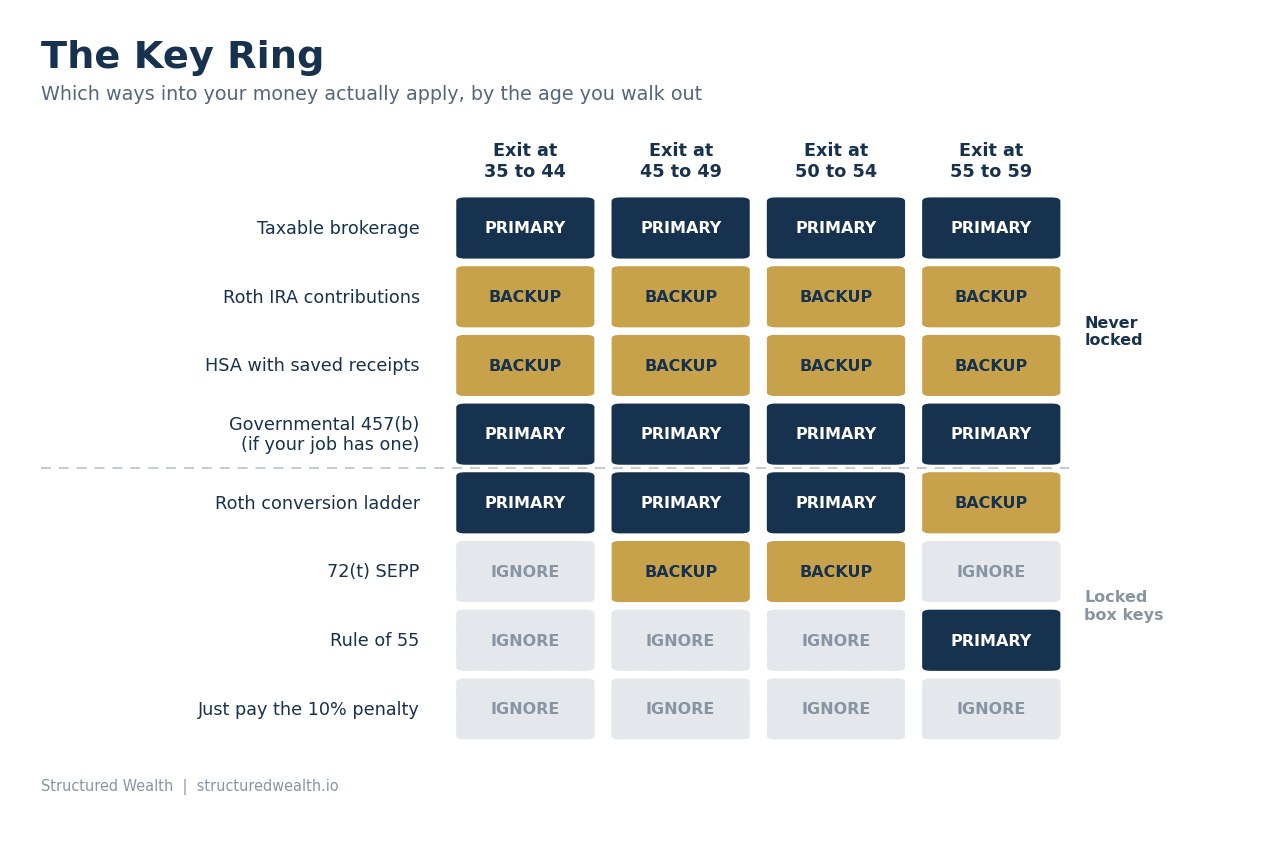
Three things fall out of that grid, and they’re the whole argument.
First, the top half never locks. The brokerage, your Roth contributions, the HSA with receipts, and a governmental 457(b) after you separate all work at any age with no waiting, no schedule, and no paperwork. If you’re leaving before 45, the top half plus the ladder is your entire plan. Everything below the dashed line is somebody else’s article.
Second, the two keys a lot of articles lead with are the two you should ignore. The 72(t) and the Rule of 55 get top billing on Fidelity, Schwab, and every listicle written for the general public, because the general public retires at 62. Both are dark for an exit at 40. Fidelity isn’t wrong. They’re writing for somebody else.
Third, and this is the one that costs years, the ring rewards whoever starts earliest. Rung one of the ladder needs five years to season. The brokerage bridge needs a decade of contributions to reach a size that matters. You have to solve this problem long before you have it, which is why so many people discover the locked box at 39 with nothing built beside it.
Here’s the honest limit on all of it. I haven’t run a conversion ladder yet. I’ve built the bridge, I’ve mapped the rungs, I’ve modeled the tax years, and the first real rung gets converted the year I actually quit. Everything on this page about the mechanics is verifiable against the tax code. Everything about how it feels to live on it is still ahead of me.
If you just realized four of your eight keys are dark and the bright ones are the accounts you’ve been underfunding, that’s the same species of quiet mistake I put in a free guide. Ten of them, with real numbers on each. Get the 10 Quiet Mistakes That Kill Your Early Retirement and check your plan against every one.
The Order You Build This In
Reading order for everything in this pillar, in the sequence the decisions actually arrive.
1. Size the bridge first. Every key on the ring gets easier, bigger, and safer with a taxable account behind it, and the bridge is the one thing that has to exist before you quit. How big should a taxable brokerage bridge account be works the number three different ways and shows why the same couple can justify wildly different answers.
2. Pick your key to the pretax money. For almost everyone under 50 that’s the ladder, and the ladder versus 72(t) comparison at 40 shows why it isn’t close. Read this before you read the mechanics, because choosing wrong here costs you two decades of flexibility.
3. Build the ladder with real numbers. A full ladder example, year by year, for a couple retiring at 40 on $120,000 a year, including the 2026 trap that catches people who size their first rung by feel.
4. Add the account most people leave on the table. The HSA receipt strategy turns a decade of out of pocket medical bills into a penalty free withdrawal you can take at any age. It’s the smallest key on the ring and the one with the best tax treatment in the entire code.
What you do this week
All of that is about getting money out. The decision in front of you today is which accounts you keep putting money INTO, and it’s the one that decides how hard this gets.
Standard advice says max the traditional 401k every year forever. For a future early retiree, maxing it indefinitely is one of the dumbest default moves in personal finance. Not because the 401k is bad. Because “indefinitely” ignores where that road ends, which is required minimum distributions at 75 for anyone born in 1960 or later under SECURE 2.0, on the government’s schedule, taxed as ordinary income, with a 25% penalty on anything you fail to take.
So run two tests. The first is your coast point, the balance that grows to fully fund normal retirement at 59½ and beyond with zero additional contributions. The Coast FI Check card in my early retirement calculator gives you that number in five minutes. Past it, cut 401k contributions to the employer match and never below it, then point the entire difference at the accounts with early doors. Brokerage first and biggest. Backdoor Roth every year. HSA to the max if you have a high deductible plan. That redirect is most of the reason I’m sitting near $1 million at 33 on a household income around $200,000.
The second test is the one the coast point can’t see. Your coast point is a floor. It only asks whether today’s balance is already enough, and it says nothing about how big that pile gets by the day you quit. Stop contributing at $450,000 at 29, take nothing but the match, and at 7% real returns you still walk out at 40 with roughly $947,000. So there’s a separate ceiling on how much pretax money you can move out cheaply before 59½, and plenty of people cross it years after the pivot told them they were done. How much pretax is too much works out that number.
And if you’ve already got the pretax side handled and you’re deciding where the next dollar goes, the mega backdoor Roth versus taxable brokerage question prices the flexibility premium in actual dollars. I ranked those two wrong for years.
The half of this pillar I haven’t written yet
Reaching the money is one problem. Staying insured is the other, and I’ve written almost nothing on it, so I’m not going to pretend this page is finished.
What exists today is the income side. The $84,600 cliff covers how your subsidy gets decided and what one dollar over the line costs, which matters enormously once you’re setting your own income through conversions. What doesn’t exist yet is the coverage side. COBRA versus the marketplace, what a plan actually costs a 40 year old, how to shop it the year you quit. That’s the next thing I build here.
Common Questions About Reaching Your Money Early
Can I actually get 401k money before 59½ without the penalty?
Yes, several ways. Convert it through a Roth ladder and wait five years per rung, run a 72(t) payment schedule, use the Rule of 55 if you separate at 55 or later, or qualify for one of the hardship exceptions. The penalty applies to unplanned grabs, and you’re not going to be unplanned.
When do I start my conversion ladder?
Convert the first rung five tax years before you want to spend it, and every clock starts January 1 of its conversion year. Retiring at 40 and want ladder money flowing at 45? Rung one gets converted the year you retire, when your bracket craters.
Which key should I use if I’m leaving at 40?
The brokerage bridge carries you, the Roth conversion ladder opens the pretax money, and Roth contributions plus an HSA with saved receipts sit behind both as backup. Skip the 72(t) and the Rule of 55 entirely. Neither one is available or worth the handcuffs at that age.
Is it dumb to keep money in pretax accounts at all?
No. Deductions at your peak bracket, converted later at your floor bracket, are the single best tax trade available to a high earner. The dumb part is growing that pile past your coast point and letting the RMD math compound against you for 40 years.
Your action step takes one evening. Open the early retirement calculator and get your coast number. Past it, log into your 401k, set the contribution to the match, and put the freed up dollars on auto transfer to your brokerage. Under it, keep maxing and rerun the number every January. Either way it hits every payday automatically and GGs, you’re done. The system runs in the background while you live your life.
I’ll leave you with why I care this much. Some nights I work 10 or 12 hours, come home, and my daughter wants to show me a picture she’s coloring, and I’m falling asleep sitting next to her. That feeling is what an extra decade of unnecessary work actually costs. Not dollars. That. Your money was never really locked. Don’t let one misread rule, or one account you’re overfeeding, price fifteen years of your one life.
Get the 10 Quiet Mistakes That Kill Your Early Retirement. The 401k mistake above is the same species as all ten. Real numbers on every one, about ten minutes to read.
Email, guide, done.
Where these numbers come from. Every 2026 figure on this page traces to IRS Notice 2025-67, Revenue Procedure 2025-32, or Revenue Procedure 2025-19, all linked or named above. Growth projections use 7% real, which is roughly what the S&P 500 has returned after inflation since 1926. Past returns don’t promise future ones. I make money if you eventually buy the Early Retirement Blueprint, and the guide above is free either way. I’m a mechanical engineer who has run this plan on my own money for a decade, not a licensed financial advisor, so take this as one guy showing his work and check anything that matters against a professional who knows your situation.