
By Antonio Hill
Every retirement article hands you the same withdrawal order. Spend your taxable brokerage first, then your traditional 401(k) and IRA. Save your Roth for last. It isn’t wrong, exactly. It’s just built for a 65 year old with Social Security coming in and a 30 year retirement to fund.
You’re 40. You’ve got a 10% penalty wall standing in front of half your money, a health insurance cliff you can fall off of, and the cheapest tax years of your entire life sitting there unused. Even though the accounts might be the same, the way you use them can be a lot different.
So here’s the short version, and then I’ll show you the math. You still spend taxable first. But at the same time, every single year, you move traditional money into a Roth, right up to the income line that protects your health insurance. You use your already taxed Roth contributions to plug the gaps. And you spend Roth growth dead last. The order isn’t a rulebook you memorize. It’s whatever keeps you clear of four walls, so you keep the most options open. That last part is the most important concept.
One thing I want to be straight about before you read another word. This is a framework for finding your order, not a claim that I’ve calculated the mathematically perfect sequence for you. Nobody can honestly write that in an article. The truly optimal withdrawal path is a numbers problem solved household by household, with your balances, your state, your health coverage, and your spending in it. What I can do is show you the constraints that decide it, tell you where I’ve landed for my own plan, and flag every place where smart people go the other direction. Where I’m giving you my opinion instead of a rule, I’ll make it clear.
The Standard Withdrawal Order, and Who It’s Actually For
The conventional answer, the one Fidelity and most retirement resources will give you, is taxable, then tax deferred, then Roth. Let your tax advantaged accounts compound as long as possible, and pay taxes as late as possible.
And look, it isn’t stupid advice. It’s the easy default that keeps people from blowing up their retirements. Draining your Roth first, or paying a penalty you didn’t have to, does far more damage than getting the order slightly wrong. So as a way to keep the average retiree from making a catastrophic mistake, the standard order does its job.
It just quietly assumes three things about you: that Social Security is sitting underneath your plan, that you’re old enough to touch every account without a penalty, and that your money only has to last 30 years, not 50.
You are none of those things. Social Security is decades away and you’re smart to leave it out of the math entirely. A big chunk of your money is locked behind a penalty until 59.5, and if you retire at 40 and live to 90, your plan has to survive twice as long as the one that order was tested on. When the assumptions are that far off, the advice built on them isn’t neutral. It’s actively working against you.
Four Walls Decide Your Order, Not a Rulebook
I’m a reliability engineer. Most of my actual job is mapping the constraints on a system before it fails, instead of reacting after it breaks. Your withdrawal order works the same way. Stop trying to memorize a sequence. Find the walls, and the order falls out on its own.
Wall One. The 59.5 Penalty Wall
Pull money out of a traditional 401(k) or IRA before 59.5 and you generally hand the IRS a 10% penalty on top of the income tax. That’s the wall standing in front of your biggest accounts. There are legitimate doors through it, and I broke them all down in how early retirees reach their money before 59.5. But the one rule I’ll give you flat out is this: it is almost always wrong to pay that 10% penalty. If you’re staring down a penalty to fund your spending, you didn’t save enough to retire yet. Sorry ’bout your luck.
Wall Two. The ACA Subsidy Cliff
Here’s the one almost nobody models, and it’s the one that reshaped my own plan. Before Medicare kicks in at 65, most early retirees buy health insurance on the ACA marketplace. How much you pay depends on your income. Show too much, and you don’t just lose a little. You fall off a cliff. the ACA cliff. Ok, sorry. I had to try it.
Those enhanced subsidies that softened the cliff for a few years? They expired on January 1, 2026. The hard 400% of poverty cliff is back. For a married couple in 2026 that line sits at $84,600 of income. One dollar over and the subsidy is gone, and for tax years after 2025 there’s no cap on paying it back. KFF estimates that losing these credits more than doubles what a subsidized household pays, a 114% jump on average. I ran the exact damage in the $84,600 cliff, and for a family it’s a five figure swing.
Now here’s why it lands on the withdrawal order. A Roth conversion counts as income. Realized capital gains count as income. Traditional withdrawals count as income. Every move the standard order tells you to make can shove you over that line. I want to be clear that this won’t be the top priority for everyone. If you’ve got retiree health coverage from an old employer, or a spouse still working with a plan, the cliff barely matters to you. But for me, in my first years off the paycheck, it’s the wall I plan around first, because losing those subsidies raises what my wife and I spend by more than any tax I’d save going the other way.
Wall Three. The Conversion Window
The years right after you retire, before Social Security, before any pension, before RMDs, are the lowest income years you will ever have again. That’s not a problem. That’s the single best tax opportunity of your life, and it slams shut a little more every year you age into more income.
So you use it. Every year you convert traditional money into a Roth while you’re sitting in a low bracket, paying little or nothing on the way. The Mad Fientist, who popularized this whole approach, calls the Roth conversion ladder a great way to reach that money early, and he’s right. I walked through it with real numbers in the Roth conversion ladder, and the reason it’s free is covered in how a retired couple pulls six figures and pays $0 in federal tax. Skip this window and you’ll pay the tax later anyway, at a worse rate, on the government’s schedule instead of yours.
Wall Four. The Age 75 RMD Wall
Leave a traditional account alone and it doesn’t stay quiet. It grows into a tax bomb. At age 75 the IRS forces you to start pulling it out and paying ordinary income tax on it, ready or not. That’s required minimum distributions, and for anyone born in 1960 or later, the wall is 75.
The good news is you can see it coming from 35 years out. That’s the entire point of converting during the window. You’ve got from 40 to 75 to quietly drain that traditional account down before it ever forces your hand. Waste those years and a fat traditional balance turns into forced income right when you have the least flexibility to do anything about it. There is a specific balance above which that cleanup stops being possible at a low rate, and I worked out where that line sits.
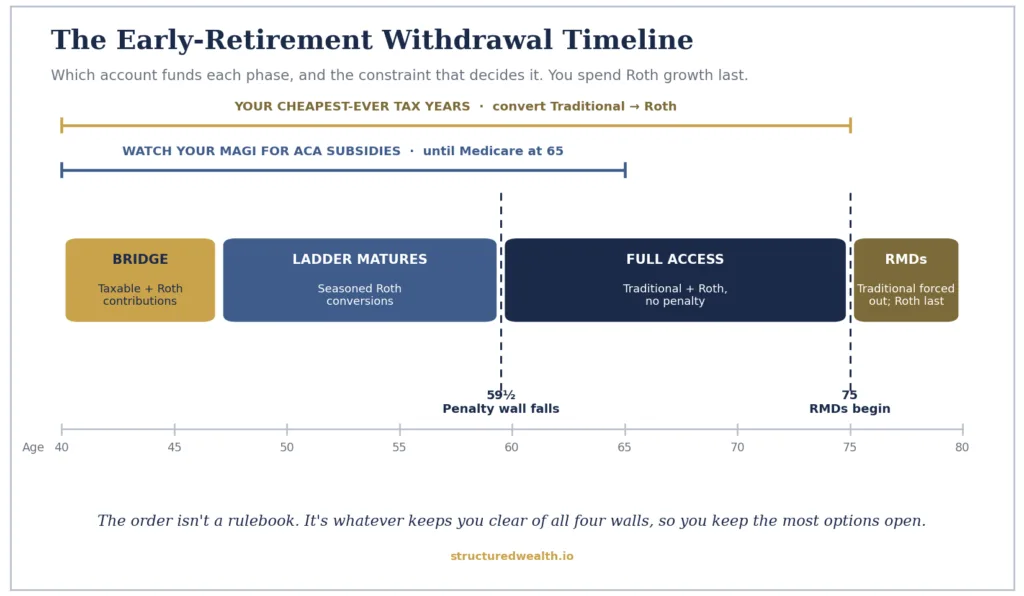
How the Four Walls Set Your Order
Map those four walls onto your accounts and the sequence mostly builds itself. Here’s what it looks like, in order of what you spend and when, with the honest note on each one about how settled it actually is.
- Lean on taxable first, but never purely. The brokerage carries most of your early spending. No age restrictions, no penalty, and when you sell, only the gain counts as income, not the money you originally put in. So you can pull a lot of cash out of taxable while keeping reported income low, and how low depends entirely on which tax lots you sell. Worth knowing that draining taxable completely before touching anything else is the part researchers argue with. Kirsten Cook, William Meyer, and William Reichenstein tested it in the Financial Analysts Journal and found that sequencing strategically, instead of emptying one account at a time, made the money last years longer. The authors have put the average gain at about seven years. Michael Kitces landed in the same place from a different direction, and his version is the one that stuck with me. Take distributions from each account along the way. Running conversions alongside your taxable spending, which is the next step, is how you capture most of that without building a model.
- Convert traditional to Roth every year while your income is low. At the same time you’re spending taxable, you convert. The real question is how much, and this is where I’ll flag that my answer is a judgment call rather than settled math. I will cap my conversions at the ACA cliff, because subsidies are how my family will get affordable health insurance and losing them would cost us more per year than the tax I’d save converting harder. That’s my call for my situation. The other side is real. Capping at the cliff every year can leave a traditional balance big enough that the lifetime tax bill beats what you saved on premiums. Some households do better going lumpy, blowing well past the cliff for two or three years, eating the full premium on purpose, then sitting quietly under the line the rest of the time. Run both before you assume the simpler version wins.
- Bridge the five year wait with Roth contributions. Each conversion has to season for five years before you can touch it penalty free. So how do you eat in years one through five? Your Roth contributions, the money you put in, come out anytime, tax free, penalty free, and they don’t count toward your ACA income. They’re the perfect bridge fuel. So are HSA reimbursements against old receipts, for the same reason. The rough rule the FIRE crowd has used for years is to keep around five years of spending reachable outside your retirement accounts before you pull the trigger.
- Spend Roth growth dead last. The growth inside your Roth is the best dollar you own. It compounds completely tax free, it has no RMDs while you’re alive, and it’s the cleanest thing you can hand your kids. You protect that as long as humanly possible. It should almost always be the last money you ever touch.
Take the same couple I used in the ladder piece above. Retiring at 40, spending $120,000 a year, with money split across all three account types. They keep their ACA subsidy by holding reported income under $84,600, which they can do because most of their spending comes from taxable basis and Roth contributions that don’t count as income. That leaves them room to convert only about $30,000 to Roth this year, not the roughly $133,000 the tax brackets alone would have permitted. The cliff, not the bracket, set the number. That’s the whole idea in one line.
Here’s the part that matters for you, though. Every one of the studies behind that advice was built on a 65 year old. Reichenstein and Meyer’s actual advice is to draw down traditional money early and convert while you wait to claim Social Security at 70. T. Rowe Price ran the same play in June 2026 with a couple named Tom and Linda, both 65, holding $2 million across three account types. They pulled around $130,000 a year from the traditional account before Social Security started, rather than spending taxable first. Same shape as what I just told you to do. Different wall. They’re bridging to a Social Security check and steering around Medicare surcharges. You’re bridging to 59.5 and steering around a subsidy cliff that literature never models, because their retirees turn 65 and go on Medicare and never meet it. The structure holds up. The walls are yours to find.
There’s a third contender for that same room, and it’s the part of my own plan I’m still chewing on. Harvesting capital gains at 0% and converting to a Roth both eat the same income space under the same cliff. Every dollar of gain you realize tax free is a dollar you can’t convert, and the reverse. Three good moves, one budget, and they fight each other. My original plan was to run 0% gains for 20 straight years until I actually put the ACA cliff and the conversion window on the same page and watched them collide. If you only take one planning idea from this article, make it that these three decisions get made together, in the same spreadsheet, in the same year.
And here’s what this article does not cover, because I’d rather say it than let you assume it – no state taxes, and some states will change your answer. No IRMAA, the Medicare surcharge that shows up decades later and gets driven by the same income decisions. No pensions, no rental income, no business income. Those all move the numbers. The four walls still frame the problem, but your solution inside them is yours.
Want your own two numbers instead of a couple you’ve never met? Run your split through the early retirement calculator. The Bridge Years card shows exactly how many years you have to cover before 59.5 and whether your taxable and Roth money actually stretches that far.
The One Line That Turns a Tax Win Into a Loss
Here’s the mistake the standard order walks you straight into, and it’s a quiet one. It tells you that once taxable runs low, you start draining your traditional accounts. For you that means one of two bad things. Either you’re under 59.5 and eating a 10% penalty, or you’re pulling a big traditional withdrawal that spikes your reported income right over the ACA line.
Cross that line and the math gets ugly fast. The subsidy doesn’t shrink. It vanishes, and after 2025 you repay every advance dollar of it with no cap. You can easily lose more in health insurance than you ever saved in taxes by “optimizing” the withdrawal. A tax win on paper becomes a real cash loss. That’s not a rounding error over a 50 year retirement. It’s one of the most expensive mistakes an early retiree can make, and it’s completely invisible if you’re just following the old order.
The subsidy trap is one of ten quiet mistakes I keep reading about people walking into. Nobody blows up an early retirement with one loud decision. It’s the quiet stuff that compounds against you for a decade before you notice it. I wrote up the ten I see most often, the ones smart, high earning people make while they’re convinced everything is on track.
Spending It Down Changes Which Account You Drain
Now the part that’ll rub some people wrong. This obsession with preserving your principal, with never touching the pile, is backwards for an early retiree. The 4% rule and most withdrawal strategies are built to keep your portfolio roughly intact until you die. I don’t want that. And I don’t think you should either.
I plan to spend my taxable bridge all the way down to zero, on purpose. I plan to draw most of my retirement accounts down over the rest of my life. I’ll probably still leave something to my kids, because I can’t predict the day I die and there’ll be money left over. But I’m not planning around it. What I’m handing them is the knowledge to build their own money.
That’s my position, not a research finding, and the counterargument deserves some thought. Spending down means accepting a real chance you outlive the plan, and a 50 year retirement gives that chance a lot of room to work. If leaving a large inheritance is a goal you actually hold, or a thinner margin would keep you up at night, preserving principal is a legitimate choice and you should ignore me here. What I won’t accept is drifting into principal preservation by default, never deciding it, and paying for it with five extra years at a desk.
This isn’t just a mindset. It changes the order. If the bridge is built to hit zero at 59.5 instead of surviving intact, you spend it harder and earlier, which leaves more room under the ACA cliff for conversions in those same years. Preserve it instead and you end up pulling from the account you least want to touch. The accumulation saving is smaller than most people assume once you run it in real terms over a 50 year retirement, but the effect on your sequencing is immediate. I broke down the actual math, and how to set a floor and a ceiling instead of just refusing to touch the pile, in should you spend down your principal in retirement. It’s the same reason a rigid 4% rule inflates your number, and it’s why pairing this order with a flexible withdrawal rate gets you out years sooner on the same portfolio. Christine Benz at Morningstar calls the old 4% guideline a blunt instrument, and she’s being polite. The one real danger to respect while you spend down is a bad market in your first few years, which I covered in sequence of returns risk. Manage that, and spending down is the plan, not the risk.
Step back and you can see what actually ties all of this together. It was never really about which account you touch first. A fixed order and a preserved pile are both just ways of refusing to adapt, and refusing to adapt is what costs you money and years. The whole point of sequencing around those four walls, and of planning to spend down, is the same thing. Options. You’re engineering flexibility, so you can live the way you want now and still have moves left later.
Withdrawal order is the last of four decisions in the full plan, and it’s the smallest one. See how it fits with the other three.
Your Order Isn’t Mine. Build Your Own.
Let me be honest about something, because it’s the honest version that’s actually useful. I haven’t landed on a final withdrawal plan myself. The more I dig into the interaction between the ACA cliff, my conversions, and harvesting gains at 0%, the more my own order shifts. That used to bother me. It doesn’t anymore, because that shifting room is the flexibility doing exactly what it’s supposed to do. If your plan can flex, it can’t be “wrong.” It can only adapt.
So don’t copy my order. Build yours this week.
- Write down your three buckets and their balances. Taxable, traditional, and Roth split into contributions versus growth. Most people have never actually separated that last one, and it matters.
- Find your two income lines. Your ACA cliff for your household size, and the ceiling of the 0% capital gains bracket, which is $98,900 of taxable income for a married couple in 2026 on top of the $32,200 standard deduction.
- Size your bridge. Run your numbers through the calculator’s Bridge Years card and see whether your reachable money actually covers the gap to 59.5.
- Start converting the year you retire. Then make the cliff decision on purpose rather than by accident. Either you stay under it every year like I plan to, or you go lumpy and pay full premiums in a few heavy conversion years. Pick one, and know why you picked it.
- Decide now which account funds which phase, using that timeline above, and write it down while you’re thinking clearly.
The best withdrawal strategy was never about taking money from the right account first. It’s about giving yourself options, so you can maximize living the way you want, now and thirty years from now. Get that right and the account order mostly sorts itself out. GGs.
Get the 10 quiet mistakes that kill early retirements.
Following the wrong withdrawal order is one of them. The other nine are the ones I read about smart, high earning people making while they’re sure everything’s on track. Free, straight to your inbox. Send me the guide
Questions People Ask About Withdrawal Order in Early Retirement
Which account should I withdraw from first in early retirement?
Taxable brokerage carries most of the early spending, because it has no penalty and only the gain portion counts as income. But you convert traditional money to Roth alongside it every year while your income is low, and you spend Roth growth last. The exact order depends on how much sits in each account and which of the four walls binds first for you.
Is there one optimal withdrawal order for everyone?
No. The genuinely optimal sequence is a numbers problem solved per household, using your balances, your state taxes, your health coverage, and your spending. Research favors pulling from more than one account type in the same year to fill a target bracket, rather than strictly emptying one account before starting the next. Cook, Meyer, and Reichenstein found in the Financial Analysts Journal that sequencing this way made portfolios last years longer than the conventional order. Worth knowing that this research was built on retirees in their sixties, so it prices in Social Security and Medicare rather than the penalty wall and the subsidy cliff you’re facing. Treat the four walls as the frame for your decision, not a rule that replaces running your own numbers.
Do Roth conversions count as income for ACA subsidies?
Yes. A Roth conversion adds to your modified adjusted gross income for the year, dollar for dollar. That’s exactly why the ACA cliff, not your tax bracket, usually caps how much you can convert. Withdrawing your original Roth contributions, on the other hand, does not count as income.
Can I withdraw from my 401(k) or traditional IRA before 59.5?
Not without a plan. A straight withdrawal before 59.5 usually costs a 10% penalty on top of income tax. The legitimate routes around it are a Roth conversion ladder, the rule of 55, and 72(t) payments, all covered in the guide to reaching your money before 59.5. Paying the raw penalty is almost always the wrong move.
Should I spend my Roth first or last?
Your Roth contributions can be spent early as bridge fuel, since they come out tax and penalty free. But your Roth growth should be the very last money you touch. It compounds tax free, has no required distributions while you’re alive, and is the best asset to leave to heirs.
Is the standard taxable, then traditional, then Roth order ever right?
Sometimes, yes. If you have health coverage outside the marketplace and don’t need to manage income for subsidies, the standard order is a perfectly reasonable default. It fails specifically for early retirees who rely on ACA subsidies and haven’t used their low income years to convert. Know which situation you’re in.
I’m not a licensed financial advisor and none of this is financial advice. It’s my own research and my own plan.