
By Antonio Hill
Pay your medical bills out of pocket, keep the receipts, and you can reimburse yourself tax free at 45 for a dental bill you paid at 33. The money sits in your HSA compounding the entire time. No waiting period. No age gate. No paperwork beyond your own folders. Oh yeah, did I mention no taxes?
That is the HSA receipt reimbursement strategy, and the reason it matters years later has almost nothing to do with healthcare. It is a bridge account. It is the cleanest bridge account in the entire tax code, and almost nobody talks about it that way. It sits alongside the brokerage bridge and the Roth ladder as one of the ways into your money before 59½, and I ranked all of them by exit age in the full breakdown of your options.
Here is where I have to give the personal finance crowd credit, which I do not do often. Most finance peeps get HSAs mostly right. Over ten years of reading this stuff, the HSA is the one place where the knowledgeable people are basically unanimous in how powerful it is. They understand the triple tax break. They tell you to invest it instead of swiping it. Plenty of them explain the receipt strategy exactly the way I just did, down to the part where the reimbursement can go toward anything you want.
So this is not an article about people being wrong. They stop one step short, and the step they stop short of is a big deal for anyone retiring at 40.
Almost every version of this you will read sells the receipt stack as flexibility. Freedom to spend it whenever, on whatever, and not only on healthcare. All true, but not complete. The flexibility that matters at 40 has less to do with what you can buy and everything to do with what buying it costs you on paper. You can dial your spending up or down by thousands of dollars in a single year and your MAGI does not move. Roof goes. Kid needs braces. You want three weeks in Portugal. Pull it from the HSA via reimbursements and the income number your MAGI (the number that determines your early retirement healthcare premiums) sits exactly where you left it.
That is the property nobody puts in the headline. Tax free income that does not raise your MAGI by a single dollar, in the exact years when MAGI is the one number holding your whole plan together.
Everybody calls the HSA triple tax advantaged. For an early retiree there is a fourth advantage, and it is worth more than the other three combined.
The Receipt Stack That You Should Count As a Bridge Account
Your bridge is the pile of money that carries you from the day you quit to the day the retirement accounts open up without friction. Most people build it out of a taxable brokerage account and a Roth conversion ladder. Both work. Both cost you something.
The receipt stack costs you nothing.
Say you are 33 and you have a $2,400 year of medical bills. Two kid urgent care visits, a crown, the deductible on a procedure. You pay all of it from your checking account. You scan every receipt. The $2,400 stays in your HSA and keeps compounding. At 44, eleven years later, you pull $2,400 out of the HSA against those old receipts and spend it on a trip to Japan. Legally. Tax free. Because a qualified distribution is a qualified distribution whether you take it the week of the bill or eleven years after.
The IRS does not impose a deadline. There is no five year seasoning like a Roth conversion. There is no 59 and a half like a traditional IRA. There is no 55, no separation from service, no substantially equal periodic payment schedule you are locked into for years. You decide when.
The Two Rules That Actually Bind
There are exactly two, and the second one is the one people blow.
One. You keep the records. The burden is entirely on you. No custodian tracks this. If you get looked at, you produce the receipt and proof you never claimed it elsewhere. A folder in your cloud drive, one file per year.
Two. The expense has to happen after your HSA exists. An HSA is established when it gets funded, not when you sign up for the high deductible plan. Every dollar of medical spending before that funding date is dead to you forever. You cannot go back.
Which means if you have a high deductible plan and no HSA open, stop reading and go open one with fifty dollars in it. That fifty dollar deposit starts the clock on every receipt you will generate for the rest of your life.
There is a rescue provision worth knowing if you have had an HSA before and drained it. Under IRS Notice 2008-59, Q&A 41, any later HSA is deemed to be established when the first HSA was established, as long as you held an HSA with a balance above zero at some point in the 18 months ending when the new one opens. So do not zero out an old HSA to close it. Leave a dollar in there. That dollar is holding your establishment date open.
I am living this one right now. I cannot contribute to an HSA at the moment, my current plan does not qualify, and I will be able to again later. My old account stays open with a balance in it, and every medical expense my family generates in the meantime still goes in the folder. The account being frozen does not freeze the receipts.
The MAGI Cost of a Bridge Dollar
In early retirement you are not just choosing where to get spending money. You are choosing what that money does to your modified adjusted gross income, because MAGI is the number that decides your health insurance subsidy and how much room you have left to run Roth conversions under the cliff. Every bridge dollar has a MAGI price tag. Most people never look at it.
You are 42, retired, and you need $10,000 to live on. Here is what each source costs you on the line that actually matters.
| Where the $10,000 comes from | MAGI it creates | Conversion room it eats | Taxed on the way in? |
|---|---|---|---|
| HSA reimbursement against an old receipt | $0 | None | No |
| Roth IRA contributions you already made | $0 | None | Yes, at your peak earning rate |
| Plain cash savings | $0 | None | Yes, at your peak earning rate |
| Brokerage shares sold at roughly your cost basis | Close to $0 | Almost none | Yes |
| Brokerage shares with a 50% embedded gain | $5,000 | $5,000 | Partly |
| Seasoned Roth ladder principal | $0 today | Already spent, five years ago | No |
| 72(t) payments from a traditional IRA | $10,000 | $10,000 | No |
| Straight 401(k) withdrawal with the penalty | $10,000 | $10,000 | No, and you eat 10% on top |
Read the top row again. One line in that table is clean in all three columns. Untaxed going in, invisible on your MAGI coming out, and it does not touch your conversion room. Nothing else in the tax code does all three at once.
Roth basis is close, and it is genuinely great, and you paid full freight to put it there. Cash is close, same problem. Every other row makes you choose between having money and keeping your subsidy.
That middle column is the one the HSA writeups leave out. They will tell you the reimbursement comes out tax free, which is correct and which everybody says. Very few of them go on to say it also comes out MAGI free, and that second property is the one deciding whether you keep a five figure health insurance subsidy. Tax free is the headline. MAGI free is the money.
Why This Is the Fight You Are Actually In
If you are retiring before Medicare, you are buying insurance on the exchange. The enhanced subsidies that softened the edges expired at the end of 2025, so for 2026 coverage the hard cliff is back. Go one dollar over 400% of the federal poverty level and your entire premium tax credit vanishes. For a household of two that line sits at $84,600 for 2026 coverage, calculated off the 2025 poverty guidelines.
One dollar. Thousands of dollars of subsidy. I wrote about how brutal that math gets in the ACA subsidy cliff breakdown, and it is the single tightest constraint in an early retirement plan.
So you are running a budget on a line you cannot cross, and you are trying to fit Roth conversions, capital gains, and living expenses underneath it all at once. That is the three-way squeeze. Read the table again with that in mind. The receipt stack is the only source of spending money that does not compete for space under the ceiling.
Three Mistakes That Turn a Freedom Account Into a Debit Card
People make the same three, and plenty of people make all three at once.
They swipe the card as bills come in. Which is understandable. Medical costs are insane even with decent insurance, and if you do not have the cash to absorb a $1,800 bill you are going to use the account that was built for it. Fair. But every swipe permanently shrinks the balance in the best tax wrapper you will ever have, and the annual contribution cap means you cannot just put it back.
They do not max it. The limits are small. For 2026 you get $4,400 self only and $8,750 for a family, plus $1,000 more if you are 55 or older, per the IRS figures. Small enough that a high earner can fill it without noticing. When I had access I maxed mine alongside my 401(k), not instead of it. It was never an either or.
They leave it in cash. This one hurts the most and it is the most common. Devenir’s 2025 year end research report puts total HSA assets near $174 billion across 41.7 million accounts, and only about 4.2 million of those accounts hold any invested dollars at all. Roughly one in ten. EBRI’s data lands in the same range. So nine out of ten people holding the most tax advantaged account in America are earning a money market rate on it.
I have made exactly this mistake in a different account. March 2020, I opened my brokerage, put in $10,000 right as COVID tanked the market, and then froze. Watched red day after red day and could not make myself click buy. It sat in cash for two months while the market ripped back up without me. The money was in the right place. I just never turned it on. An uninvested HSA is that same mistake, except it runs for twenty years instead of two months.
The quiet mistakes are the expensive ones
Leaving an HSA in cash is one of ten slow leaks that add years to an early retirement timeline without ever announcing themselves. I put all ten in a free guide, with the math on what each one costs you.Get the 10 Quiet Mistakes
What Shoeboxing Actually Earns You
Go read the popular shoebox articles and you will find numbers like $28,000, or $290,000, presented as what the strategy earns you. Those numbers are wrong. They compare an HSA you left alone against an HSA you spent down, and they quietly ignore the cash you kept in your pocket by not spending it. That cash does not evaporate. It goes into your brokerage account and compounds too.
The honest comparison is one dollar in an HSA against that same dollar in a taxable brokerage account. Same money, same fund, different wrapper. Here is what that actually looks like.
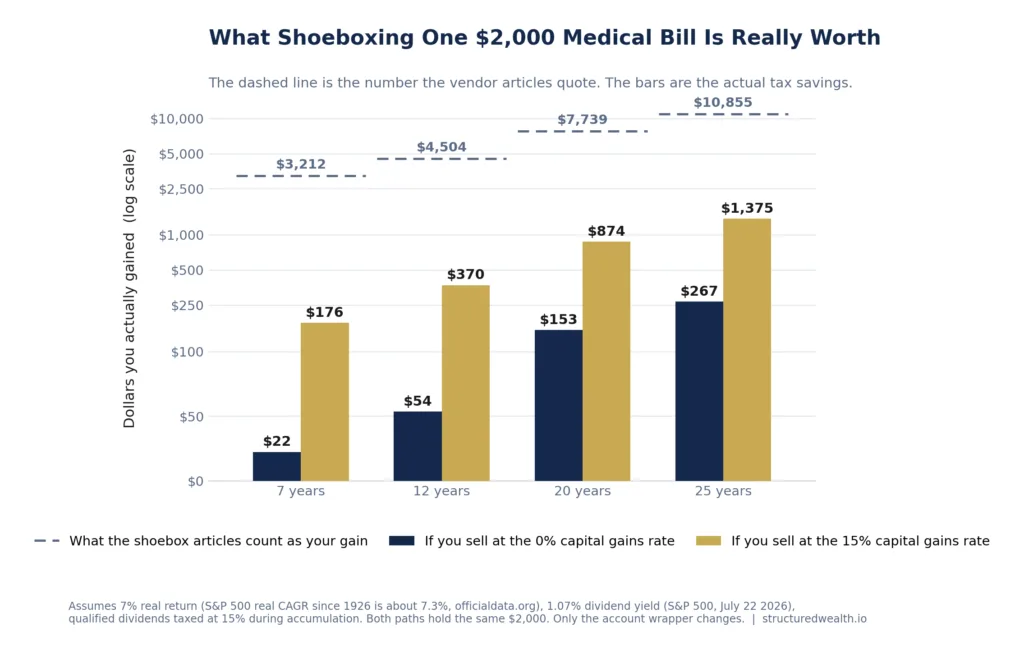
Shoebox a $2,000 bill for twelve years and the pure tax advantage is $370 if you sell those brokerage shares at the 15% capital gains rate. If you engineer your income well enough to sell in the 0% bracket, which is exactly what you should be doing, the advantage collapses to about $54.
Fifty four dollars. That is the real dollar edge on a strategy people write countless posts about.
The Number That Actually Matters
So is the whole thing overhyped? No. The dollar case is weak. The MAGI case is enormous.
Selling $2,000 of brokerage shares with a $1,000 gain adds $1,000 to your MAGI. Reimbursing yourself $2,000 from the HSA adds nothing. If you are running a couple thousand dollars below the cliff, that gain is the difference between keeping a subsidy worth five figures and losing all of it. The receipt stack is not a way to squeeze out an extra fifty bucks of growth. It is a way to spend money without spending MAGI, and MAGI is the scarce resource in early retirement.
Every dollar needs a job. The job of an HSA dollar is not to pay a dentist. It is to give you spending power that your health insurance never sees.
Retiring Early No Longer Ends Your HSA
This is new as of this year and it changes a few things in a meaningful way.
For twenty years the HSA had an obvious ceiling for anyone retiring early. You needed a qualifying high deductible plan to contribute, exchange plans generally did not qualify, so the day you quit your job was the day contributions stopped.
That ended January 1, 2026. Under the One Big Beautiful Bill Act and IRS Notice 2026-5, every Bronze and Catastrophic plan offered through an Exchange is now treated as a high deductible health plan for HSA purposes, whether or not it meets the old deductible and out of pocket tests. Off exchange versions of the same plan count too. Catastrophic plans still carry their own age and hardship restrictions, so for a 40 year old the realistic path is Bronze.
Read what that means. You retire at 40, you buy a Bronze plan on the exchange, and you keep contributing to an HSA. The account does not go dormant. It keeps taking deposits for the entire bridge.
The Conversion Room Math
Here is where the two halves of this article snap together.
The HSA deduction sits above the line. It lands on Schedule 1 and reduces your AGI directly, and ACA MAGI is built on AGI. So a dollar of HSA contribution is a dollar off your MAGI. One for one. You do not need earned income to take it, which matters enormously when your only income is a Roth conversion you generated on purpose.
Married couple, both 40, retired, on a Bronze plan. Their ceiling is $84,600. Without an HSA they can convert up to that number and stop.
Contribute the $8,750 family maximum and they can convert $93,350 and still land at $84,600 of MAGI. Same subsidy. Same cliff. $8,750 more traditional money moved into Roth, at a very low effective rate, every single year of the ladder. Run it for five years and that is $43,750 of extra converted principal walking through the door, each tranche becoming penalty free five years after its conversion. The mechanics of that timeline are in the Roth conversion ladder walkthrough.
The move most people miss. Where does a retiree get $8,750 to contribute? From the taxable brokerage account they were going to live on anyway. So you sell brokerage shares, take the small gain, and move that money into an HSA. You just converted a bridge dollar that creates MAGI into a bridge dollar that never will, and the government paid you a deduction for doing it.
What This Looks Like for One Couple
Numbers make it real. Two people, both 40, both retired, Bronze plan, household of two, and they need $90,000 a year to live on. Fifteen thousand of that comes out of Roth contributions they made years ago, free and clear. The rest has to come from the taxable brokerage, and their shares carry a 50% embedded gain, so every dollar they sell drags half a dollar of capital gain onto the return.
Couple one never kept a receipt. They sell $75,000 of shares to cover the gap, which throws off $37,500 of capital gains. That eats $37,500 of their $84,600 ceiling before they convert a single dollar. What is left for Roth conversions is $47,100.
Couple two has been shoeboxing for twelve years. They reimburse themselves $12,000 out of the stack, so they only need $63,000 from the brokerage. They sell another $8,750 on top of that to fund this year’s HSA contribution, because a Bronze plan qualifies now. Total sales $71,750, capital gains $35,875, and then the $8,750 deduction comes off the top. Their living costs them $27,125 of MAGI. Room left for conversions is $57,475.
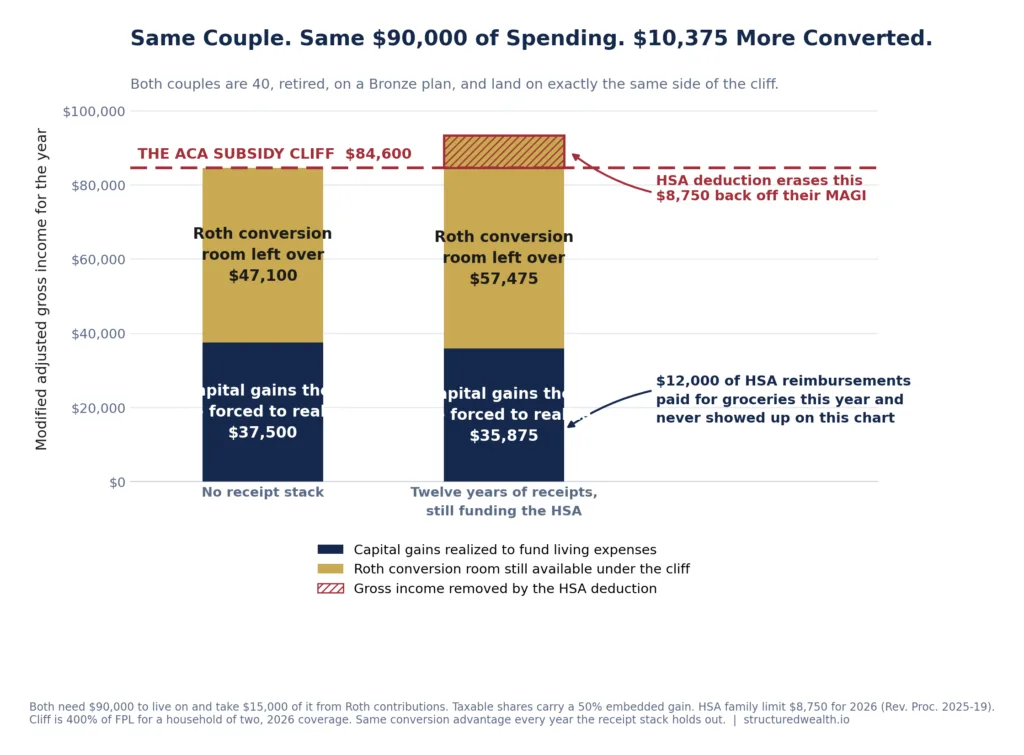
Same two people. Same $90,000 of spending. Same side of the cliff, down to the dollar. Couple two moves $10,375 more into Roth for it, and if the receipt stack holds through a five year ladder that is $51,875 of extra converted principal.
Now look at what is missing from that chart. The $12,000 that paid for groceries and gas and the mortgage is not on it anywhere. It never touched the ceiling. That is the entire idea.
Two honest limits on that example. Both couples still owe tax on what they convert and they pay it out of the same brokerage, and couple two converts more so they owe a little more, which trims the gap some. The direction does not change. And the receipt stack is finite. Twelve years of family out of pocket costs might build $35,000 or $40,000, and drawing $12,000 a year burns it in three. It refills, though, because you are on a Bronze plan paying real money out of pocket every year, and every one of those bills goes right back in the folder.
That is a genuinely broken mechanic, and I mean broken the way a gamer means it. Overpowered. So strong it feels like the designers forgot to test it. The HSA was already the only account with a triple tax break, and now it stays open through early retirement and doubles as a lever on your subsidy. It is the most broken account we have.
Two more caveats. California and New Jersey do not conform to the federal treatment, so contributions and internal earnings are taxable at the state level there. And a contribution made from the sidelines only gets you the income tax deduction, not the payroll tax break you got when it came out of a paycheck.
How to Start Your Receipt Stack This Week
None of this requires discipline. It requires a folder and one afternoon.
Open and fund an HSA today if you have a qualifying plan. Any amount. The establishment date is the only thing you can never get back.
Make one folder in your cloud drive. Subfolders by year. Every explanation of benefits, every pharmacy receipt, every copay. Photograph it at the counter and forget about it.
Check whether your balance is actually invested. Log in right now. If it says money market or savings, you are one of the nine in ten. Most custodians make you keep a small cash minimum and let you invest everything above it. Move it, set it to auto invest, and GGs, you never think about it again.
Pay medical bills from checking from here forward. This is the only part that costs you anything, and what it costs is liquidity, not money.
Track your running total. One spreadsheet column. That number is a real, spendable, zero MAGI asset and it belongs in your bridge plan next to your taxable account, not buried in a healthcare line item. When you size your number for retiring at 40, the stack counts, and the early retirement calculator will show you how many bridge years it has to cover.
The reason more people do not do this has nothing to do with fear of an audit. We live in a world built on instant gratification. Something that pays off in fifteen years fights human nature, which is the same reason people cannot leave a brokerage account alone through a downturn. The behavior is the hard part. The mechanics take twenty minutes.
The HSA is a freedom account. Tax free in, tax free growth, tax free out, invisible to the income number your health insurance reads, and now it survives the day you quit. Four advantages, not three. Take it seriously.
Get the 10 Quiet Mistakes That Kill Your Early Retirement. An uninvested HSA is one of them. The other nine are just as quiet and just as expensive, and every one of them is costing somebody reading this a year or more of freedom.
Questions People Actually Ask
How far back can I reimburse myself from an HSA?
All the way back to the date your HSA was first funded, with no deadline after that. A 2014 expense can be reimbursed in 2044 if the account existed in 2014 and you still have the receipt. Expenses incurred before the account was funded can never be reimbursed. See IRS Publication 969.
Does an HSA reimbursement count as income for ACA subsidies?
No. A distribution used for qualified medical expenses is excluded from gross income, so it never reaches your AGI and never reaches your ACA MAGI. That is the entire strategic point of the receipt stack for an early retiree.
What proof do I need to keep?
The receipt or explanation of benefits showing the expense, the date, and that it qualifies, plus your own confirmation that you never claimed it through insurance or an FSA. You self report on Form 8889. Nobody checks unless you get examined, and then the burden is entirely yours.
How long does an HSA reimbursement take?
One to three business days if you transfer electronically to a linked bank account, and one to two weeks if your custodian mails a check. Some custodians make you upload documentation before they release anything. Others let you self certify and just move the money. None of that changes the tax treatment, so the delay is a customer service question rather than a tax one. Run a small reimbursement once while nothing is urgent, so you know your own custodian’s speed before you are relying on it for living expenses.
How long do I need to keep HSA receipts?
Indefinitely, which is not the usual answer for tax records. Most paperwork you can drop after the three year assessment window. An HSA receipt is different because you are holding it as a claim you have not made yet, so it has to survive until the year you actually reimburse yourself, plus the audit window after that. Shoebox a bill at 33 and reimburse it at 50 and that receipt needs to be readable seventeen years later and for a few years beyond. That is the real argument for scanning everything instead of trusting a drawer.
What happens if I lose a receipt?
You lose that reimbursement. That is the whole risk. Digital copies solve it, and most providers and insurers keep multi year claim histories you can download if you need to rebuild.
Can I contribute to an HSA after I retire early?
Now, yes. Starting with months after December 31, 2025, Bronze and Catastrophic Exchange plans count as qualifying high deductible plans under IRS Notice 2026-5. Before that change most exchange plans did not qualify and contributions stopped when you left your employer plan.
What if I take money out and I do not have a receipt?
Before 65 it is ordinary income plus a 20% additional tax. Not 10%. The 20% figure trips up a lot of published articles. At 65 the extra 20% disappears and the account behaves like a traditional IRA for anything non medical.
Should I max the HSA before the 401(k)?
Get your full employer match first, always. After that I would fill the HSA before anything else, and in practice the limits are small enough that a decent earner does not have to choose. Fill both.
I write about my own strategy. The free guide linked above is genuinely free and I am not compensated by any HSA custodian, insurer, or software company mentioned here. This is educational content, not personalized tax or investment advice. Tax rules change and your situation is not mine, so confirm anything here against current IRS guidance or a professional before acting on it.