
By Antonio Hill
In the bridge account piece I wrote that the lever is basis, not balance, and then moved on to the next thing. This is the part I skipped.
Open your brokerage. Find total gain in dollars. Divide it by your account balance, not by your cost basis. That percentage is roughly how much of every dollar you pull out lands on your tax return as income.
Your broker shows you a different number. On the index fund account below, the screen reads 81%. The number that gets taxed is 45%.
And 45% isn’t fixed either. On the same account, on the same day, the same $100,000 withdrawal can create $20,949 of taxable income or $65,186 of it. That’s a choice you make at the moment of sale, and it’s usually made by a default setting instead.
Why Your Broker’s Percentage Uses the Wrong Denominator
Here’s the account. Real S&P 500 price returns, one purchase a year from 2018 through 2026, contributions escalating from $12,000 up to $48,000 as the paycheck grew. Nothing sold, nothing rebalanced.
Total contributed, $253,000. Worth today, $458,940. Gain of $205,940.
Your brokerage screen computes gain divided by cost basis. $205,940 over $253,000 is 81.4%, and that’s a fair answer to how much your money grew.
It’s the wrong denominator for retirement. When you sell shares, your basis comes back to you untaxed and stays invisible to your adjusted gross income. Only the gain shows up. So the number you need is gain divided by market value, which is $205,940 over $458,940, or 44.9%.
That gap isn’t rounding. Read the screen number as your tax exposure and you’ll plan for a bill nearly twice the real one.
One more denominator nobody mentions
Cash makes it worse. Most brokerages leave settled cash out of that account level percentage, which means the figure gets less accurate the more dry powder you hold. Add $10,000 of cash to the account above and the displayed number doesn’t move at all, while your actual conversion rate falls again.
I check my own taxable account most days. Every column, most mornings. I still had the wrong number in my head, because I’d been reading the one printed in green at the bottom of the page.
The Same $100,000 Withdrawal, Three Ways
That 44.9% only applies if you sell proportionally across everything, which almost nobody does. What you own is nine separate tax lots with nine separate cost bases, and you get to pick.
Same fund. Same day. Same $100,000 in your checking account.
Sell your oldest shares first and you hand the IRS $65,186 of income. Sell your newest shares first and you hand them $20,949. The difference is $44,237, and it costs nothing to capture except knowing which button to press.
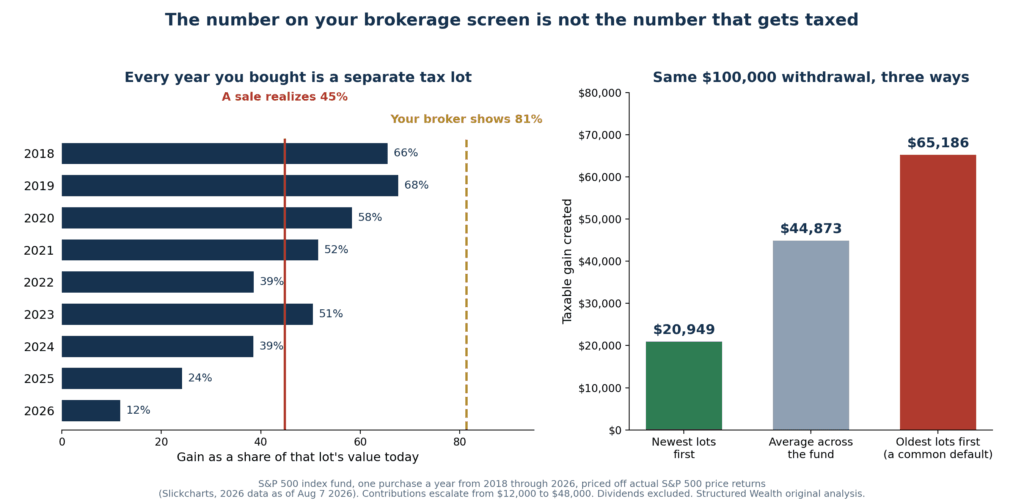
First in, first out is the default at plenty of brokerages, and average cost is the default on plenty of mutual funds. If you’ve never changed that setting, the expensive column is the one running on your account right now.
What this does to your conversion room
Run it against the real constraint. A household of two loses every dollar of ACA premium subsidy above $84,600 in 2026, and that cliff came back this year after the enhanced credits expired. It’s a hard edge, not a phase out. I broke down the mechanics in the subsidy cliff piece.
That account also throws off about $5,966 a year in dividends whether you want them or not.
| How you sell | Gain realized | Plus dividends | Room left under the cliff |
|---|---|---|---|
| Oldest lots first | $65,186 | $71,152 | $13,448 |
| Proportional | $44,873 | $50,839 | $33,761 |
| Newest lots first | $20,949 | $26,915 | $57,685 |
That last column is Roth conversion room, and it’s the whole game in the bridge years. Selling in the right order buys you $44,237 of extra conversion space every single year. Across a fifteen year bridge that’s roughly $660,000 of pretax money you get to move at a low rate instead of leaving it to come out at 22% or more later. I put a number on that ceiling in how much pretax is too much.
One setting. Two thirds of a million dollars of arbitrage.
Basis Inventory
Here’s the name for what you’re actually managing.
Basis Inventory is the supply of low gain lots you can sell without creating much taxable income. It isn’t a percentage. It’s a stack, and every year you spend from the account you burn through the cheap end and leave the expensive end behind.
Watch what happens when you spend $60,000 a year out of that same account, always selling the lowest gain lots first, with the rest growing at 7% real.
| Year | Gain realized | Share of the withdrawal | Account left | Gain ratio on what’s left |
|---|---|---|---|---|
| 1 | $13,542 | 22.6% | $431,065 | 52.1% |
| 3 | $29,885 | 49.8% | $369,327 | 62.5% |
| 5 | $37,759 | 62.9% | $298,642 | 70.4% |
| 8 | $44,704 | 74.5% | $172,956 | 79.7% |
| 10 | $49,679 | 82.8% | $73,817 | 83.6% |
Year one you realize 22 cents on the dollar and feel like a genius. Year ten you realize 83 cents and there’s nothing left to sell but 2019 shares.
Nothing went wrong there. The strategy worked exactly as designed, and working is what depleted it. You spent your good basis first because that’s the correct order, and the bill you deferred is still standing at the back of the line.
This is the part I don’t see anywhere in the withdrawal order advice. Sell your lowest gain lots first is right, and it’s also a resource you can run out of.
Your worst timed buys are your best withdrawal inventory
Look at the 2022 row on the chart. Somebody who bought in January 2022, weeks before an 18% drawdown, sits at a 39% gain ratio today. The person who waited and bought in January 2023 sits at 51%.
The bad timer has better basis. Their money bought fewer shares at a higher price, so more of what they hold is principal coming back untaxed.
Nobody should want a bear market. But if you’ve been dollar cost averaging through one and quietly hating it, those are the shares that fund your first few years of freedom at almost no tax cost. I’d rather have bought low. I’ll take the consolation prize.
You Can’t Harvest Your Way Out of This While You’re Working
The obvious fix is to sell winners now, pay the tax, buy them back at a higher basis, and reset the whole thing. There’s no wash sale rule on gains, so you can rebuy the same fund the same minute.
At a $200,000 household income, don’t. I ran the full MAGI math on this timing question separately, including the one exception where paying early actually wins.
You’d be volunteering for 15% federal today to avoid a bill you might pay at 0% later. In 2026 a married couple can stack the $32,200 standard deduction against the $98,900 zero rate ceiling and realize $131,100 of long term gains at no federal tax at all, which is the machinery behind pulling six figures and paying nothing. Push past $250,000 of modified AGI while you’re still earning and you add another 3.8% on top through the net investment income tax.
I’d only heard of gain harvesting recently myself, and my first instinct was that it sounded clever enough to be a trap. It isn’t. It’s a tool with one right season, and that season starts the day the paycheck stops.
So what do you do with losses
Harvest them. Now. And understand the trade you’re making.
Every loss you book lowers your basis in whatever you buy back, which grows your future embedded gain. Selling at a loss and rebuying feels free and isn’t. I’ve wanted a big loss carryforward and a low gain ratio at the same time for years, and those two things fight each other. You don’t get both.
Here’s how the trade resolves. A loss harvested while you’re working offsets gains taxed at 15%, or up to $3,000 a year of ordinary income at 22% or 24%. The same loss carried into early retirement offsets gains that would have been taxed at zero. Jeffrey Levine, chief planning officer at Focus Partners Wealth, put it plainly in a July 2026 interview when he said “you may have wasted losses that could have been more valuable later” if those gains would have landed in the 0% bracket anyway.
Read that backwards and you get the rule. Losses are worth the most at your highest marginal rate, which is right now. Banking a carryforward to spend in your zero bracket years wastes it, and you can’t even choose to hold it, because losses offset current year gains automatically before anything carries forward.
Harvest losses while they’re expensive to give up. Harvest gains when they’re cheap to take. Those are different years.
Four Moves That Cost Nothing Today
Compute the real number. Total gain divided by account value. Write it down next to what your broker displays. If they’re far apart, everything you’ve assumed about your bridge account has been running on the wrong input, including whatever you put into the calculator.
Switch your cost basis method to specific identification. It’s a settings change, it takes five minutes, and it’s the highest return five minutes in this article. Do it before you sell anything, because average cost on a mutual fund binds the shares you’ve already sold under it.
Open the lot view. Position level data hides all of this. You need the screen that lists purchase dates and per lot basis. Fidelity calls it View Lots, on the Action menu beside each position. Schwab calls it Lot Details, in the same spot. Vanguard files it under Cost Basis, unrealized gains and losses, off the Holdings page. All of them sit two clicks deeper than anyone goes.
Send new money at your worst inventory problem. Every contribution creates a fresh high basis lot, which is Basis Inventory you’re stocking for a decade from now. Of the three levers, contributions are the one you own outright while you’re still working, and this is a second job they do that nobody counts. It’s also part of what an extra year of work actually buys you, beyond the balance.
Then leave it alone. This is a twice a year check, not a hobby.
What I Still Don’t Know
I’m six and a half years out, and several inputs here are guesses rather than calculations for me personally. What my positions look like at 40. Whether my wife’s income is in the picture. Where the ACA rules sit by then, given the cliff already vanished once and came back. So I run conservative and I’ll rerun all of it when I’m two years out and the guessing stops.
The mechanics don’t move, though. Basis is basis, lots are lots, and the order you sell in is yours either way. Whether I hit my target realized fraction across twenty years is genuinely open. Whether selling the right lots beats selling the wrong ones isn’t.
There’s a version of this where you do everything right and still land at a 70% gain ratio at 55, because the market ran and you had less to sell than you planned. Getting there with the good lots already spent is fine. Getting there because your broker sold oldest first for nine years and never asked is not. I built the taxable account before I understood any of this, which is most of how I got to a million and also why I’m cleaning it up now instead of at 39.
Ten minutes in your settings today is worth more than any withdrawal strategy you’ll read this year. Withdrawal order across account types sits on top of this decision, not underneath it.
An unchecked cost basis setting is the quietest version of mistake eight in the free guide, leaving free money on the table.
Quick Answers
What percentage of my brokerage account is actually taxable?
Only the gain, and only when you sell. Divide your total unrealized gain by your account value, not by your cost basis, and that fraction is roughly what a proportional sale puts on your return. The account above shows 81% on the screen and converts at 45%. Your basis comes back to you untaxed and never touches your adjusted gross income.
Is a high unrealized gain percentage bad?
It means your money worked, and it also means each dollar of spending costs you more taxable income than it would have five years ago. The problem isn’t the percentage. It’s discovering it at 39 instead of 33, when there’s no time left to build fresh basis around it.
Should I sell winners now to reset my cost basis?
Not while you’re earning six figures. You’d pay 15% today, plus 3.8% above $250,000 of modified AGI, to avoid a bill a married couple can often clear at 0% once the salary stops. Gain harvesting belongs in low income years. Loss harvesting belongs in high income years.
Does selling from a brokerage account count against ACA subsidies?
The realized gain does. The return of basis doesn’t. That’s why lot selection matters so much before 65, since a household of two loses the entire premium subsidy above $84,600 in 2026 and the gain you realize funding your own groceries counts toward it.
Which lots should I sell first in early retirement?
Lowest gain first, which usually means newest, with one exception. Any lot held twelve months or less is a short term gain taxed as ordinary income, so season it before you touch it.
I write about my own strategy and my own plan. The free guide linked above is genuinely free, and it puts you on my email list where I also sell The Early Retirement Blueprint. I am not compensated by any custodian, broker, or insurer mentioned here. I am a mechanical engineer, not a licensed advisor, and this is educational content rather than personalized tax or investment advice. All projections use the stated assumptions and are not predictions.