
By Antonio Hill
You better have a good plan.
That is the first thing I think when somebody tells me they are looking at a 72(t). Not “great idea.” Not “here is how.” Just, I hope you have thought this all the way through, because you are about to make a promise to the IRS that you cannot take back for a while.
So here is my answer before anything else. If you are retiring unusually early, build the Roth conversion ladder. The 72(t) is a last resort. Every article you will read compares these two on your account balances. That is the wrong variable. The variable that actually decides this is your age. Let me show you.
What You Are Actually Signing Up For
Both of these solve the same annoying problem. You have a pile of money in a 401(k) or an IRA, you want to retire way before 59½, and the government slaps a 10% penalty on anything you pull out early.
The Roth conversion ladder gets around it with patience. Every year you move a chunk of pretax money into a Roth IRA and pay the tax on it. Wait five years, and you can spend that chunk without the penalty. Do it every year and after the first five years, a fresh batch comes free every year after that. I walked through the whole thing with real numbers in the ladder article.
The 72(t) gets around it with a promise. You tell the IRS you will take out a specific amount every single year, calculated their way. Then you take exactly that. Not more. Not less. You cannot add money to the account. You cannot pull extra out for a new roof. You just take the payment, every year, until you turn 59½ or five years pass, whichever takes longer.
Read that last part again, because that is the dominant concept.
Whichever takes longer.
If you start at 57, you are committed for five years. Annoying, but survivable. If you start at 40, you are committed until 59½. That is nineteen and a half years of doing exactly one thing, the same way, no matter what happens in your life.
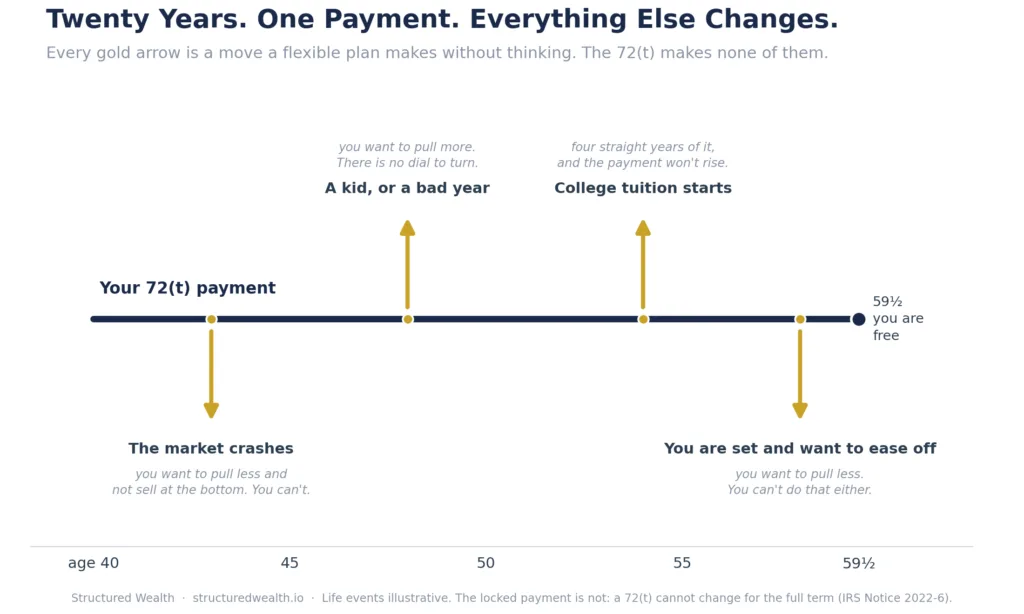
Nineteen and a half years. Think about what that actually means. A kid born the week you retire will be a junior in college before that plan lets go of you. My daughter is two. If I started a 72(t) today, she would be finishing a degree before I got my flexibility back.
Sean Mullaney is a CPA who wrote the book on early retirement taxes, and he has the best line I have found on it. He says “The 72(t) IRA should be thought of as a locked cage.” Nothing goes in. One payment comes out a year. That is it.
What breaking it costs. Take a dollar too much, take a dollar too little, roll the account somewhere else, or add money to it, and the IRS treats the whole thing as broken. Then they go back and charge the 10% penalty on every payment you already took, plus interest. Break a plan in year 15 after pulling $60,000 a year, and you are looking at roughly $126,000. That is not a fee. That is a car and a year of college.
The mistakes that quietly wreck early retirements are rarely the loud ones. Locking yourself into a twenty year payment schedule at 40 is exactly the kind of decision that feels smart on a spreadsheet and hurts for two decades. I put ten of these in a free guide.
Is This A Scam?
You would assume the 72(t) pays you a lot more when you start young, or when you commit for a longer term, like a CD. It does not. The IRS math spreads your balance over your life expectancy, and at 40 you have a longer life expectancy than at 55, so each year’s slice is actually smaller.
I ran the numbers using the current IRS rules and the method that pays out the most. Here is what you actually get.
| Age you start | What it pays each year | Years you are locked in |
|---|---|---|
| 40 | 5.51% of the account | 19.5 |
| 45 | 5.60% | 14.5 |
| 50 | 5.71% | 9.5 |
| 55 | 5.87% | 5.0 |
Look at those two columns next to each other.
Going from 55 to 40 costs you about a third of one percent in yearly income. In exchange, you take on almost four times the commitment. You are handing over fourteen and a half extra years of flexibility and getting basically nothing back for it.
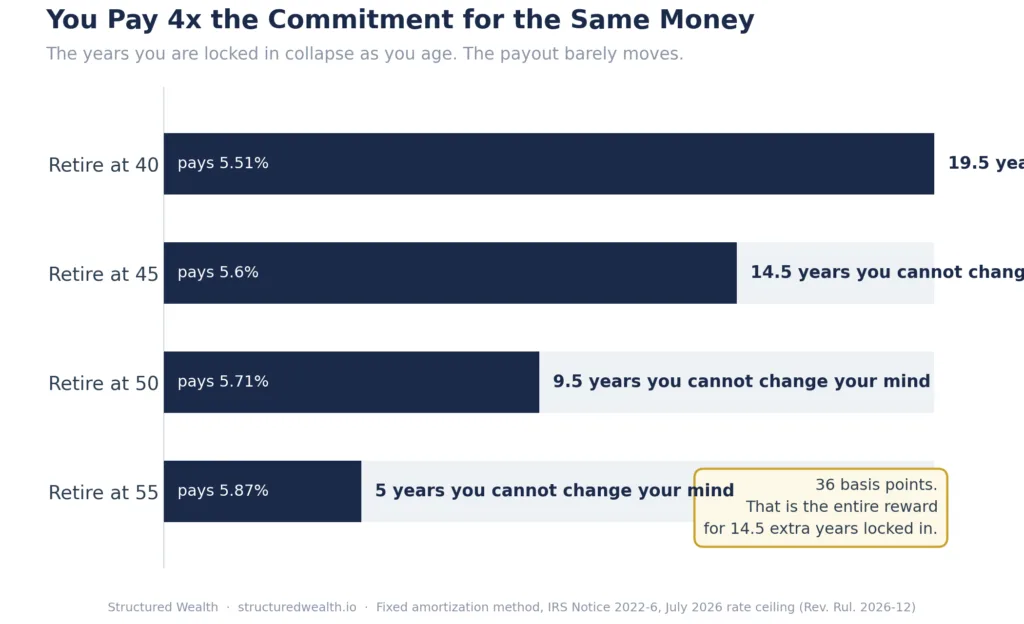
Nobody would sign that deal if somebody wrote it out this way. So let me write it out this way.
Mullaney, the same CPA, describes the rule change that made 72(t) payments bigger as the thing that opened the strategy up for people “in your 50s.” Not 40s. The guy who literally wrote the book frames this as a tool for the decade before you turn 60. That matches what I think, and I did not know he had said it until I went looking.
What Happens When the Market Drops
This is the worst part.
Say you and your spouse retire at 40 and need $85,000 a year from pretax money. To generate that under the IRS formula, you need about $1.54 million sitting in the 72(t) account. Fine. That is 5.51% coming out. A little high, but you have a plan.
Now the market drops 40% in year two.
Your payment does not drop with it. It cannot. It is a fixed number you promised to the IRS. So now you are pulling that same $85,000 out of an account worth $925,000, which is a 9.18% withdrawal rate, and you are contractually stuck doing it for another eighteen and a half years.
I ran that out. Assuming a normal 7% recovery after the crash, the account runs dry in year 19. Six months before the lock even expires.
That is sequence of returns risk. In a normal early retirement, you handle a bad year by spending less for a while. That is the entire idea behind a guardrails withdrawal strategy, where your spending flexes with the market instead of ignoring it. The 72(t) takes that option off the table on purpose.
One small mercy. If the account genuinely runs to zero while you followed the rules, the IRS does not treat that as breaking the plan and does not come after you for the penalty. You just have no money. Which, honestly, is not much of a mercy.
The Health Insurance Trap
Here is the one that gets missed constantly, and it might be the most expensive.
Your 72(t) payment counts as regular income. In 2026 the enhanced health insurance subsidies expired, so the old hard cutoff is back. A married couple earning one dollar over $84,600 loses every penny of their subsidy. Not a smaller subsidy. Zero. I broke that down in the $84,600 cliff article.
Now go back to that couple who needed $85,000 a year.
Their 72(t) payment alone puts them $400 over the line. Four hundred dollars. And they cannot fix it, because the payment is fixed. Every year. For nineteen and a half years. That is potentially tens of thousands of dollars in health insurance they are buying at full price because a formula they signed last year will not bend.
The whole thing in one sentence. A Roth conversion is a number you choose every single year. A 72(t) payment is a number that chooses you, once, for as long as two decades. When your health insurance depends on hitting an income target within a few hundred dollars, that difference is worth more than any tax savings on the table.
This is why I keep saying flexibility and taxes are not two separate goals. They are the same goal. You cannot optimize your taxes if you cannot control your income, and the 72(t) is a machine specifically designed to take that control away from you.
When a SEPP Actually Wins
I am not going to pretend this tool is useless. It exists for a reason, and there are people who should use it.
The 72(t) beats the ladder when two things are true at the same time. You cannot wait five years for the ladder to season, and the money you need is trapped in pretax accounts with no other way to reach it. That is the whole list. If you can wait, wait. If you have a taxable brokerage account, spend that.
Notice what those conditions have in common. They both describe somebody who ran out of options, not somebody who found a clever move.
And here is my hard line on it, which is my opinion and not a rule. Do not start a 72(t) before 50. Closer to 59½ is better still. At 55 the commitment is five years and the math looks completely different, and at that point you should also check whether the rule of 55 gets you there more simply, since leaving your job at 55 or later can open your current 401(k) without any of this foolishness. There is a fuller list of the ways in on the accessing money before 59½ piece.
Somebody is going to push back here. They will say if all your money is pretax at 40, the 72(t) is the only way out, so the age argument does not matter. I disagree, and here is why.
If you are 40 and every dollar you own sits in a 401(k), the honest read is not that you need a 72(t). It is that you are not ready to retire yet. You built a plan with one exit and no backup. Working eighteen more months to fund a bridge account beats locking your next twenty years to a formula. That is not a fun answer. It is the right one.
Running Both at the Same Time
There’s a middle version, and it’s the right answer more often than either extreme.
You split the IRA into two accounts before you start. One gets a 72(t) sized to cover only the gap your bridge can’t reach. The other stays free, and you convert from it every year like normal. The IRS is fine with this. The plan only governs the account it’s attached to.
The reason to bother is the five year wait. If your taxable account covers four years of spending and your first ladder conversion doesn’t come free until year six, you’ve got a twelve month hole. A small 72(t) fills it without locking up the whole balance.
Sizing it is straightforward. Retire at 40 spending $85,000, with a bridge that covers $55,000 a year, and you need $30,000. At the 5.51% payout rate from the table above, that’s about $545,000 carved into the 72(t) account. Everything above that stays yours.
What the split actually costs you
A 72(t) payment is 100% income. A brokerage withdrawal mostly isn’t.
When you sell shares, only the gain lands on your return and your basis comes back untaxed. On a taxable account running a 45% embedded gain, pulling $30,000 puts $13,500 on your return. Pulling the same $30,000 out of a 72(t) puts all of it there.
That difference comes straight out of your Roth conversion room.
| Where the $85,000 comes from | Lands in MAGI | Conversion room under the cliff |
|---|---|---|
| All from the taxable bridge | $38,250 | $46,350 |
| $55,000 bridge plus a $30,000 72(t) | $54,750 | $29,850 |
$16,500 a year of conversion room, gone, in exchange for filling a one year hole.
The part that decides it is the gap you’re covering lasts one year. The payment lasts nineteen and a half. You don’t get to stop the 72(t) when the ladder starts paying, so that $16,500 keeps disappearing every year until you’re 59½, which is roughly $320,000 of pretax money you never got to move at a low rate. It’s still sitting there when the plan finally lets go of you, and by then it’s too much pretax money, which is its own problem.
So run both if you have to. Just size the 72(t) to the smallest number that closes the gap, and know you’re renting that money for two decades to borrow it for one year.
What I Would Actually Do
Let me be straight with you about something, because I would rather say it than have you find out later.
Of everything in early retirement, this is the corner I know the least. Not because it is difficult. Because it never fit what I am building. I am retiring at 40 with a bridge account and a ladder, and a strategy that hands the IRS a twenty year promise is the opposite of how I want to live. So I never dug in. Writing this made me go learn it properly, and everything I found made me more comfortable with skipping it, not less.
Take that for what it is worth. I am not the guy who has run one. I am the guy who looked hard at it and will probably walk away completely.
So here is your action step, and it is one thing.
Add up every dollar you could spend at 40 without touching a pretax account. Taxable brokerage, cash, Roth contributions you already made. Divide it by your annual spending. If that number is five or more, you never need to think about a 72(t) again. Build the ladder and go live your life. If it is under five, you just found the actual problem, and the fix is a bigger bridge account, not a smaller life. Run your own timeline through the early retirement calculator and see what an extra year of building does to it. Usually a lot.
If you do end up in the small group who genuinely needs one, pay a CPA a flat fee to set it up and document it once. That is money well spent. What you should not do is hand somebody 1% of your portfolio every year forever for the privilege. Buy the plan. Do not rent an opinion.
The 72(t) is a real tool and it belongs in the toolbox. It is just the one at the very bottom, under the stuff you never use. Build a plan with enough options that you never have to reach for it.
Ten quiet mistakes that kill early retirements. Most of them are not dramatic. They are small structural decisions, made once, that take away your options right when you need them most. Free, no fluff, email only. Send Me the Guide
Questions People Actually Ask
Is a Roth Conversion Ladder Better Than a 72(t)?
For almost anyone retiring before 50, yes. The ladder asks you to wait five years and then gives you full control over how much income you create each year. The 72(t) gives you money right away and takes that control for as long as nineteen and a half years. Only pick the 72(t) if you cannot wait five years and have no other money to live on.
Can I Use Both a 72(t) and a Roth Conversion Ladder?
Yes. You can split your IRA, run a small 72(t) on one piece to cover the gap, and convert from the other. That is genuinely the smartest version if your bridge is only partly funded. Keep the 72(t) portion as small as you can get away with, because everything inside it stops being yours to control.
How Long Do 72(t) Payments Have to Last?
The longer of five years or until you turn 59½. Start at 57 and it is five years. Start at 40 and it is nineteen and a half. The two only tie once you are past 54 and a half.
What Happens If I Break a 72(t) Plan?
The IRS retroactively charges the 10% early withdrawal penalty on every payment you already took, plus interest for the years in between. Adding money to the account, rolling it, or taking the wrong amount all count as breaking it. There is one legal escape, a single permanent switch to the smallest of the three payment methods, and after that you are out of moves.
Does a 72(t) Payment Affect Health Insurance Subsidies?
Badly. It counts as ordinary income and you cannot adjust it. In 2026 a married couple loses their entire subsidy one dollar over $84,600, so a fixed payment near that line can cost you a subsidy every year for the whole term with nothing you can do about it.
Is a 72(t) Worth It at 40?
In my opinion, almost never. You take on roughly four times the commitment of somebody starting at 55 and the payment rate is actually slightly lower. If a 72(t) is your only path at 40, the real answer is usually that you need a bigger taxable account before you quit.
I am not a licensed financial advisor and this is not financial advice. Every dollar figure here is either from an IRS source linked in the text or from my own math on those sources, calculated in July 2026. Tax rules and subsidy thresholds change. Check them before you act.