
By Antonio Hill
Every article about tax gain harvesting tells you to sell appreciated shares in a low income year and pay 0% on the gain. Good advice. If you’re still collecting a paycheck, though, that same sale costs you 15%, and the year you quit it costs you nothing. Harvesting early is a donation to Uncle Sam.
So wait. In 2026 a married couple filing jointly pays 0% on long term capital gains up to $98,900 of taxable income, and the standard deduction adds another $32,200 on top of that. Realize $50,000 of gain at a $200,000 household income and you hand over $7,500. Realize the identical $50,000 eighteen months later, after the W2 stops, and you hand over zero.
That’s the easy part. The hard part is what your embedded gain does to you after you quit.
The Advice Was Written For Somebody Else
Read the top results for tax gain harvesting and you’ll notice something. Ameriprise, Bogleheads, every popular advisor blog. They all describe the same person. Somebody in their sixties, between the last paycheck and the first required minimum distribution, with a naturally low income year sitting in front of them.
Michael Kitces, Head of Planning Strategy at Focus Partners Wealth, describes those low income years as “a prime opportunity to recognize income at relatively low marginal tax rates.” He’s right. That’s exactly what they are.
You’re not in one. You’re 33, you make $180,000, and your low income years start the day you walk out. Taking advice built for a 62 year old and running it six years early inverts the whole point of the strategy. You’re supposed to be harvesting into a cheap year, not out of an expensive one.
Here’s what that costs in real money. Say you want to move a $1,000,000 bridge account from 50% embedded gain down to 25%. That means realizing $250,000 of gain. At $200,000 of household income you pay 15% on all of it, and the last $200,000 of that stack also clears the $250,000 net investment income tax threshold, so add 3.8% on top. Total damage, roughly $45,100.
The same repair, done across your first few years of retirement, costs $0. Same shares. Same basis reset. Forty five thousand dollars of difference, decided entirely by which side of your last day you do it on.
Your Embedded Gain Is A MAGI Budget
Now the part nobody writes, which is why the embedded gain still matters even though you shouldn’t be paying to fix it.
When you sell $100,000 of shares from your bridge account, you don’t report $100,000 of income. You report the gain portion. If your account is 40% gain, you report $40,000. If you’ve never checked which one you are, go measure your actual unrealized gain percentage before you read another paragraph, since your broker shows you a number that answers a different question.
That reported gain lands in your modified adjusted gross income. Which is the number the Affordable Care Act uses to decide whether you get a premium subsidy. And the enhanced credits that removed the income ceiling expired on December 31, 2025, so for 2026 the 400% of federal poverty level cliff is back. A household of two crosses it at $84,600. One dollar over and the credit goes to zero. Not phased down. Gone.
The average benchmark silver plan in 2026 runs $625 a month for a single 40 year old, per Peterson KFF, so about $15,000 a year for a couple. At exactly 400% of poverty your required contribution is 9.96% of income, or $8,426. The credit covering the rest is worth roughly $6,574. That’s what a single extra dollar of realized gain destroys.
So your embedded gain isn’t setting your tax bill. It’s setting how much of a fixed annual MAGI allowance gets consumed by the simple act of eating. And whatever’s left is what your Roth conversion ladder gets to use. That’s the MAGI Budget with a number attached to it.
The Same Year, Run Twice
Two couples. Both 40, both just quit, both spending $100,000 a year out of a $1,000,000 bridge account, both collecting about $12,000 in qualified dividends off it. Identical in every way except one.
Couple A sits at 50% embedded gain. Spending $100,000 realizes $50,000 of gain. Add the dividends and $62,000 of their MAGI budget is spoken for before they convert a dollar. Room left under the cliff, $22,600.
Couple B sits at 25%. Same $100,000 of spending realizes $25,000. Add dividends, $37,000 consumed. Room left, $47,600.
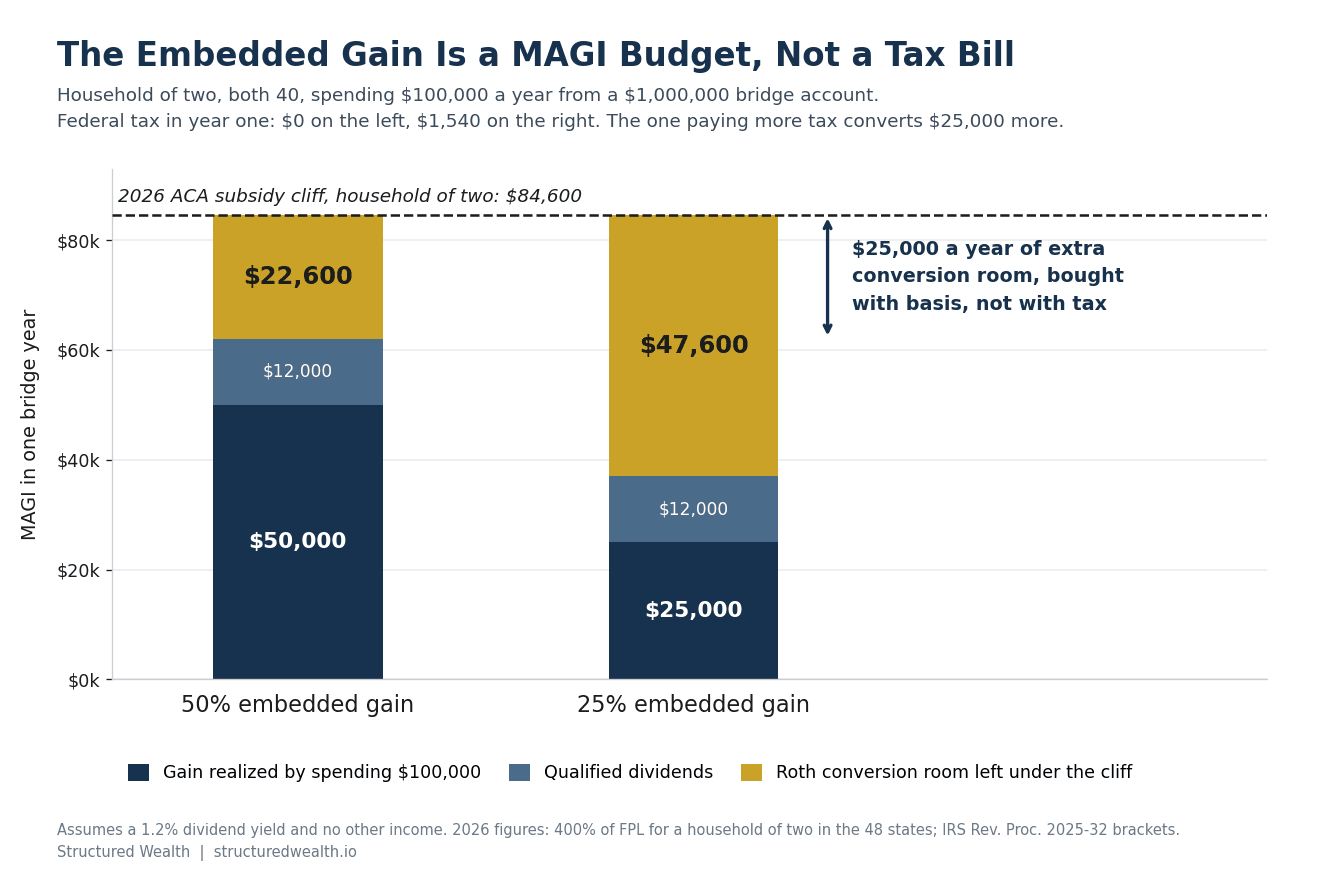
Now run the tax. Couple A converts $22,600, which the $32,200 standard deduction swallows whole, and every dollar of their gains and dividends lands inside the 0% bracket. Federal tax owed, $0.
Couple B converts $47,600. After the standard deduction that leaves $15,400 of ordinary income in the 10% bracket. Federal tax owed, $1,540. Their gains still ride at 0%.
Read that again. Couple A pays less tax. Couple A is losing. They moved $25,000 less into a Roth account this year and they’ll do it again next year and the year after, and the whole time their tax return will look cleaner than their neighbor’s. Over a five year bridge that’s $125,000 of Roth conversion capacity that quietly never happened, and it cost Couple B $7,700 in tax to capture. An effective rate of about 6% on money that would otherwise sit in a traditional account waiting to become a required minimum distribution problem at 75.
A low tax bill in the bridge years isn’t a scoreboard. Half the time it means you didn’t have room to do anything useful.
Couple B didn’t win by harvesting. They won by managing basis while they still had a paycheck. That’s a contribution decision, and contribution decisions are the ones you can still change today.
The Line Where It Stops Being Optional
Run the same household to the point of failure. Spending $100,000 with $12,000 of dividends, the gain from spending alone breaches $84,600 once your embedded gain passes about 73%.
Above that line you can’t stay under the cliff by being disciplined. You lose the subsidy by buying groceries. No conversions, no harvesting, no clever sequencing gets you back, because the spending itself is the thing blowing the budget. That’s the number to check yourself against.
Three Fixes That Cost Nothing
The gain fraction is worth lowering. Paying 15% to lower it usually isn’t. Which leaves the moves that are free, and all three are available to you right now, today, with a paycheck still coming in.
Elect specific identification as your cost basis method. Your broker defaults you to first in, first out, which sells your oldest and most appreciated shares first. Specific ID lets you pick the lot. Same sale, same cash, a fraction of the reported gain. This is the free move that shifts the number most, it takes about four minutes, and the lot level walkthrough with the actual screen names is here.
Turn off dividend reinvestment in the last year before you quit. Not for the reason people assume. Reinvested dividends buy at current prices, so they arrive as high basis lots, which helps your average. The problem is the clock. Every reinvestment starts its own twelve month holding period, so on your first day of retirement the last four quarters of DRIP purchases are short term. Sell one by accident and that gain gets taxed as ordinary income instead of riding the 0% bracket. Take the dividends in cash that final year and place them yourself.
Point new contributions at the ugliest positions. Every dollar you add at today’s price arrives with zero embedded gain and drags the whole account’s percentage down. You’re already buying something every month. Buying the thing that’s 80% gain instead of the thing that’s 20% gain costs you nothing and fixes the ratio for free.
What I Actually Have Switched On
Specific ID, yes, elected. DRIP, also on, and I’m leaving it on for now. I’m six and a half years out, so the short term lot problem is six and a half years away and every reinvestment between now and then will be long term by the time I care. I’ll flip it in my final year. If you’re inside twelve months of your last day and it’s still on, flip it this week.
I check the cost basis column most days. Not because I recommend that, but because I’m actively deploying cash and I want to know what every lot costs me before I touch it. Most people should look once a year. Once is enough to catch a 73% problem before it becomes your problem.
When Paying 15% Early Actually Wins, And When It Doesn’t
I’ve already made this case in full elsewhere, with the loss carryforward math included, in the piece on managing your gain fraction before you quit. Short version: at a $200,000 household income, harvesting a gain to reset basis costs 15% today against a bill that’s likely 0% once the paycheck stops, and a loss carryforward is worth the most against gains taxed at your current rate, not against gains that were already going to be free. That piece runs the full inversion. This one is about what the gain fraction does to you once you’re living on it.
The one exception worth naming here, since it’s specific to the ACA collision rather than the general timing question: paying 15% early can win if you’re relying on a subsidized marketplace plan, your projected gain from spending already eats most of the cliff room, and you need that room for conversions large enough to matter. That’s narrow, and it’s conditional on the 400% FPL cliff staying a cliff rather than reverting to a phase out. Size it on the calculator before you act on it, and check what your state does with the gain, since most tax it as ordinary income regardless of your federal rate.
There’s a second exception, and it isn’t really about tax. If your taxable account holds individual positions, the risk of not selling isn’t tax, it’s a single company deciding your retirement date for you. Paying 15% to exit a position that’s 80% gain and 30% of your net worth is insurance, not tax planning, and it’s the one time I’d tell you to stop optimizing and just sell.
What I’m Doing With Six Years Left
Nothing. Deliberately.
I’m not harvesting a dollar of gain before I quit. I’ll do it in the low income years when it’s free, sized against whatever MAGI room is left after I’ve fed the household and funded the conversion ladder. That was my instinct before I ran any of this math, and running it didn’t change the answer. It changed how much of it I could defend.
Two things I don’t know, and I’d rather say so than pretend. My wife plans to keep working about five years past my last day, which would hopefully give us employer coverage and make the entire cliff argument irrelevant for that window. I don’t model it. I don’t know what she’ll be doing, whether it carries insurance, or what it pays, and building a plan on a variable I can’t forecast is how people end up surprised. If it happens, it’s a bonus.
The other one is the law. The House passed a three year extension of the enhanced credits in January 2026 and it’s been sitting in the Senate ever since. If that passes, the cliff becomes a slope, the $6,574 penalty shrinks to something manageable, and exception one above loses most of its teeth. KFF found enrollment above 400% of poverty fell 44% in 2026, which tells you how many people repriced their lives around this already. Check the status before you plan around either version.
Do This Before You Quit
- Measure your gain fraction. Gain divided by account value, not gain divided by basis.
- Multiply it by your planned annual spending from the bridge. Add dividends. That’s your MAGI floor before you convert anything.
- Subtract it from your cliff. What’s left is your conversion ladder, permanently.
- If the answer is under 73%, elect specific ID and stop. Don’t pay to fix this.
- If it’s over, you have a sizing problem, not a harvesting problem. Fix it with new contributions first and the size of the bridge account itself second.
Five minutes, once a year. The one thing you should never do is pay 15% to solve a problem the calendar solves for free.
Quick Answers
Can you sell and immediately buy the same fund back?
Yes. The wash sale rule governs losses, not gains, so nothing stops you from selling an appreciated position and repurchasing it the same minute at the higher basis. That asymmetry is the entire mechanical basis of gain harvesting, and people apply the rule backwards constantly.
How much gain can a married couple realize tax free in 2026?
Long term gains ride at 0% until taxable income hits $98,900, and the $32,200 standard deduction sits underneath that, so a couple with no other income can clear roughly $131,100 of gross income with every dollar of gain untaxed federally. The full six figure version of that math is here. On a marketplace plan, though, the ACA cliff at $84,600 binds long before the tax bracket does.
Does gain harvesting compete with a Roth conversion?
Directly. Both consume the same MAGI, and if you’re managing to a subsidy cliff there’s only one budget. A dollar harvested is a dollar you can’t convert. Deciding which one gets the room is really a question about what order you pull from your accounts across the whole bridge.
What if you retire mid year?
Then your first partial year still carries most of a salary, and the 0% bracket won’t be available. Quitting in December buys you a clean January. Quitting in June means your real harvesting window opens the following year, which matters more than most people planning their first year of penalty free access account for.
You Can’t Fix Basis After You Quit. You Can Fix It Now.
Everything in this article is a decision you make while the paycheck is still landing. So are most of the decisions that actually move a retirement date, and most of them get made badly by people who are otherwise doing everything right. If you want the other nine, they’re free.
Where these numbers come from. The 2026 brackets, the $98,900 zero rate ceiling and the $32,200 standard deduction are from IRS Revenue Procedure 2025-32. The $84,600 cliff is 400% of the 2025 HHS poverty guideline for a household of two in the 48 states, applied to the 2026 plan year, with the 9.96% required contribution from Revenue Procedure 2025-25. The two worked households are composites built to illustrate the arithmetic, not real accounts.
I write about my own strategy and my own plan. The free guide linked above is genuinely free, and it puts you on my email list where I also sell The Early Retirement Blueprint. I am not compensated by any custodian, broker, or insurer mentioned here. This is educational content, not personalized tax or investment advice. Tax rules change and your situation is not mine, so confirm anything here against current IRS guidance or a professional before acting on it.