
By Antonio Hill
I ended the bridge account article by telling you the taxable first strategy leaves your pretax balance compounding into a required distribution problem at 75, and that the bill moves past the edge of that table.
Then I stopped writing. This is what’s past the edge of the table.
You have too much pretax money the moment your balance on your last day of work is bigger than what you can move out at a low rate before required distributions start. For a couple spending $80,000 that line sits somewhere between $285,000 and $1.1 million, and where you land inside that range has almost nothing to do with your 401(k). It’s decided by the cost basis in your brokerage account.
The Deadline Is 75, Not 59½
Almost everything written about this gets the deadline wrong, and I got it wrong too for longer than I want to admit.
The reason you convert before 59½ is access. You need spendable money and the age gate is in the way. I’ve written out every door through that gate, and Jim Dahle at White Coat Investor has spent years making the same correction. As he puts it, “early retirement is an exception to the age 59 1/2 penalty.”
But at 59½ the account simply opens. Nothing forces the money out and nothing stops you taking it. Converting after that is pure rate optimization. You keep going because you’d rather pay 12% now than 22% later, not because you need the cash.
The actual deadline is the first required minimum distribution, which under SECURE 2.0 lands at 75 for anyone born in 1960 or later. That’s when the IRS stops asking and starts taking, at whatever rate applies that year, stacked on top of Social Security.
Quit at 40 and that’s a 35 year window, not a 19 year one. That changes the answer completely, and mostly in your favor.
65 is when it gets easier
Before 65, your conversions are capped by the ACA subsidy cliff, which came back on January 1, 2026 when the enhanced premium credits expired. For a couple that line is $84,600 of MAGI, and I argue you should hold a 10% buffer under it, so call it $76,140.
At 65 Medicare takes over and the cliff stops existing. Your cap becomes ordinary bracket space instead, which for a married couple in 2026 means $100,800 of taxable income plus a $32,200 standard deduction, per IRS Revenue Procedure 2025-32. Roughly $133,000.
Your conversion room nearly doubles at 65 and you get ten years of it before the deadline. Nobody models those ten years, which is why the scary version of this article is wrong.
Your Grocery Money Gets to the Budget First
Here’s the part that decides everything, and it has nothing to do with your 401(k).
That cap is not a conversion budget. It’s a total income budget, and you have to live. Living means selling shares, and when you sell, only the gain counts as income. Your own basis comes back untaxed and invisible to MAGI. Your funds also pay dividends whether you touch them or not.
So a couple spending $80,000 with 30% of each sale coming back as gain burns $24,000 of the budget on groceries, plus another $12,000 or so in dividends. Of a $76,140 cap, roughly $40,000 is left to convert with.
Run the same couple at 60% gain and only $16,000 is left. Same spending, same balance, same everything. Different lots sold.
Two numbers, and people plug in the wrong one
Your brokerage has a total embedded gain, which is what your whole account would realize if you liquidated it tomorrow. Mine is 50%.
That is not the number that goes in the model.
What matters is the share of gain in the specific shares you sell in a particular year, and those are different numbers because you choose the lots. Elect specific identification with your broker, sell your highest basis shares first, and the realized fraction sits well below the account average for years. I hold 50% across the account and I plan for 30% realized. Take your account level number, put it in the table below, and you’ll frighten yourself over a problem you don’t have.
The Conversion Ceiling
Your Conversion Ceiling is the largest pretax balance you can fully clear at a low rate between your last paycheck and required distributions at 75.
| Retire at | 15% realized gain | 30% | 45% | 60% | 75% |
|---|---|---|---|---|---|
| 40 | $1,110,000 | $904,000 | $697,000 | $491,000 | $285,000 |
| 45 | $1,080,000 | $887,000 | $693,000 | $499,000 | $305,000 |
| 50 | $1,042,000 | $865,000 | $687,000 | $510,000 | $332,000 |
| 55 | $998,000 | $841,000 | $684,000 | $527,000 | $370,000 |
Read it across, then read it down.
Across, one variable takes the ceiling from $1.11 million to $285,000. That’s basis, and it’s a decision you make at your brokerage.
Down, retiring fifteen years apart moves it by about 10%, and at high gain fractions retiring later is actually better, because your bridge is smaller and throws off fewer dividends. Other articles on this topic treats your retirement age as the driver. It barely does anything.
Compare your projected balance on your last day of work to your cell. Not today’s balance. The one you’ll actually be standing on.
Almost nobody warns you about this one, because it never feels like a mistake while you’re making it. That’s true of most of them. I put the ten biggest in a free guide.
Two Households, and the Bigger Spender Wins
Take a couple, no kids, spending $80,000, leaving at 42, holding realized gain at 30%. Their ceiling is $897,405. With $750,000 projected they’re under it by about $147,000 and they’re fine. At $900,000 they’re over, barely, and they should look at their basis before they look at their contributions.
Now me. Family of four, spending $120,000, leaving at 40, same 30% realized gain. My ceiling is $1,219,120.
I spend $40,000 more a year and my ceiling is $322,000 higher.
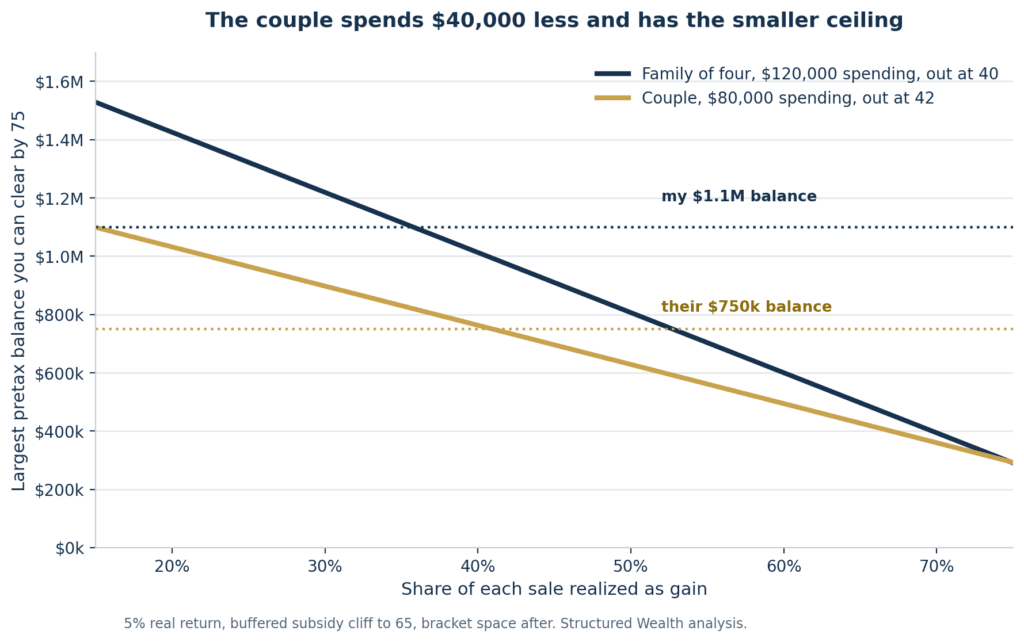
Household size did that. Four people put my cliff at $128,600 instead of $84,600, and that extra $44,000 of MAGI room every year outruns the extra spending easily. Kids are expensive in every way except this one.
My projected pretax balance at 40 is about $1.1 million, so I’m under my ceiling by $119,120. Not comfortable. Enough.
And here’s what makes me pay attention. Let my realized gain slip from 30% to 45% and my ceiling falls to $909,647. Same balance, same spending, same household, and I go from $119,000 under to $190,000 over. The whole thing turns on which lots I sell in my sixties, and I said in the bridge account piece that I can only control that partly. That’s the honest risk in my plan and it isn’t in my 401(k) at all.
The Best Argument Against Stopping
Dahle makes six arguments for maxing anyway and five of them are correct. Tax protected compounding beats a taxable account carrying a dividend drag. Retirement accounts get real creditor protection in most states. They’re easier to leave to your kids. All true, and I’m not going to pretend otherwise.
The one that matters is the arbitrage, and it’s the one that breaks.
His example runs at a 44% marginal rate, which is a surgeon in California. Run it at what a $250,000 household in a normal state faces. Take the standard deduction and taxable income sits near $217,800 before the deferral, so a maxed 401(k) pulls its first slice off the 24% bracket and the rest off the 22% bracket. Add a state rate near 5% and you’re deducting at roughly 28 cents on the dollar. Convert later inside the 12% bracket and you pay about 17 cents. Eleven cents of spread, and which state you retire in moves that number more than people expect.
Real money. Worth chasing. Right up until it isn’t there.
You only capture that spread on dollars you can actually convert cheaply. Past the ceiling you’re deducting at 28 and pulling it out at 22 plus state, decades later, on the IRS’s schedule instead of yours. The spread doesn’t shrink. It goes to zero.
I want to be precise, because the sensational version of this is wrong. Going over your ceiling doesn’t set your money on fire. It neutralizes the reason you did it. You accepted lockup, complexity, forced distributions at 75, and full exposure to whatever Congress does to brackets between now and 2065, and you got nothing back.
Ed Slott, the CPA the Wall Street Journal named its best source for IRA advice, said it better than I can when he told CNBC that “your IRA is an IOU to the IRS.” Past the ceiling that’s all it is. A debt you volunteered for.
What To Do This Week
Four numbers. Twenty minutes.
- Project your pretax balance on your retirement date. Today’s balance, plus contributions, plus the match, compounded at 5% real to the year you quit. The early retirement calculator will run that projection for you, and its Bridge Years card tells you how long the money has to stretch. The projection is the number, not what the account says now.
- Find your realized gain fraction. Not your account total. Log in, sort your lots by cost basis, and work out what fraction would be gain if you sold your highest basis shares to cover a year of spending. Most people have never looked at this column, and the percentage your broker prints at the bottom of the page is not the one you want.
- Read your ceiling off the table, then adjust for your household. Bigger household, higher cliff, higher ceiling.
- Compare the two.
Under your ceiling, keep maxing traditional. The arbitrage is live and you should take it.
Over it, do the cheap thing before the expensive thing. Elect specific identification at your broker today, because it costs nothing and it’s the biggest lever in the table. Harvest gains deliberately in low income years to reset basis upward, which is the same machinery behind realizing $131,100 tax free. Only after that should you touch contributions, and when you do, take the full match at any balance, then flip your remaining deferrals from traditional to Roth rather than stopping outright.
That order matters. Fixing your basis raises the ceiling. Cutting contributions only lowers the balance, and it costs you a deduction to do it. Most people reach for the second one because it feels like action.
One more thing, since it’ll come up. My free guide tells you to fill your tax advantaged space and I stand behind that. The match is free money at any balance, and most people reading this sit under their ceiling. This is about what happens after you cross it.
Go find your realized gain fraction this week. It’s the one number in this article you almost certainly don’t know, and it decides more than your contribution rate ever will.
Quick Answers
Doesn’t the Roth conversion ladder solve this?
The ladder is the tool, not the solution. It moves the money. The ceiling is how much it can move before the rate stops being worth paying. Here’s the ladder with real numbers and how it compares to a 72(t).
Should I switch to a Roth 401(k) or stop contributing?
Switch first, stop second. Roth deferrals don’t add to the pretax pile and still get tax protected growth, so they beat a taxable brokerage on pure math. Move to the brokerage once your bridge is short of the years between your last paycheck and 59½. If your plan allows after tax contributions there’s a third option, and I priced the mega backdoor Roth against a taxable brokerage to see which one earns the next dollar.
Does retiring later fix a pretax problem?
Barely, and not the way people assume. Retiring at 55 instead of 40 moves a couple’s ceiling from $904,000 to $841,000 at a 30% gain fraction. It goes down, not up, because you have fewer years to convert in. At high gain fractions it flips the other way since a smaller bridge throws off fewer dividends. Either way the effect is small. What retiring later does move is your balance, and I priced what five extra years actually pays.
Is the employer match ever not worth taking?
No. Take the full match at every balance and in every scenario here. Nothing else available to a normal earner pays an immediate guaranteed return just for contributing.
What if I’m single?
Your cliff is $62,600 rather than $84,600 and your standard deduction is half, so your ceiling drops sharply. Single early retirees have the tightest conversion room of anyone and should be the most aggressive about managing basis before they quit.
You found this one. There are ten more.
Quiet, slow, expensive, and almost always disguised as responsible behavior. Get the 10 Quiet Mistakes That Kill Your Early Retirement, free.
Every dollar figure here comes from a year by year model I built and ran myself, not from a study, and the assumptions sit in the table caption. Tax figures are 2026 and will change. Real returns are assumed, never guaranteed. The free guide is free and puts you on my email list, where I also sell The Early Retirement Blueprint. No custodian, broker, or plan provider pays me anything. I’m an engineer building this for my own family, not a licensed advisor, so treat it as education rather than advice.