
By Antonio Hill
Three years ago I would have told you to fill your taxable brokerage first and get to the mega backdoor Roth whenever you got around to it. I had that ranking wrong. Not backwards. Wrong for reasons that were flatly incorrect.
Here’s where I land now. Split them. Fund the mega backdoor Roth and the taxable brokerage side by side rather than picking a winner, because the Roth wins on math and the brokerage wins on access, and the size of that math advantage depends on a tax bracket twenty years out that nobody can predict. You’re paying a premium for flexibility either way. The whole question is how big that premium is, and I’m not sure anyone who tells you to max the mega backdoor has ever put a number on it.
So I did. On $30,000 a year for ten years, it’s somewhere between $15,009 and $77,299. Five times over, on the same money.
I Ranked These Two Wrong
Start with the embarrassing part.
My first exposure to after tax 401(k) contributions came from asking my company what happened if I put in too much to the pretax. The answer was that the overflow automatically lands in an after tax bucket with no tax benefit. That’s how I mentally filed it. Overflow. A place your extra money goes to sit and do nothing useful. That just told me that I want to avoid putting to much into my 401k.
Two years ago a coworker mentioned he was running a mega backdoor Roth. First time I’d heard a real person say it out loud. I went and read everything I could find, which is when I learned that the overflow bucket was a big deal, and that I’d had access to it the entire time at that job and never used it.
I don’t have access now. Different job, different plan. So I get to write about the thing I can’t do, which is its own kind of penance.
I’m not unusual here. Vanguard’s How America Saves 2026 found that 59% of participants were offered Roth in-plan conversions and 4% used them. Among people earning over $250,000, it climbs to 14%. Still means six out of seven high earners with the door open walk past it. Adam Tremper, who runs retirement platforms at T. Rowe Price, told PLANADVISER in June that adoption surprised them, since “we’re seeing more of the high-wage earners, who also skew a little bit older” rather than the young contributors they expected.
I’ve watched younger coworkers do a version of this from the other direction. They max the 401(k) because somebody told them to max the 401(k). No plan behind it, no idea what happens to the money at 40, just blind maxing because a parent or a mentor said they wished they had. Maxing is a great thing to do. It could just be a lot better.
What the Flexibility Actually Costs
Every argument on this topic runs on adjectives. The Roth is more efficient. The brokerage is more flexible. Nobody prices the trade, so you’re picking between two vibes.
Here’s the trade with numbers on it. Same $30,000 of after tax money every year for ten years, ages 30 to 40. Same investments. One version goes into a mega backdoor Roth, the other into a taxable brokerage. Then both sit until 50.
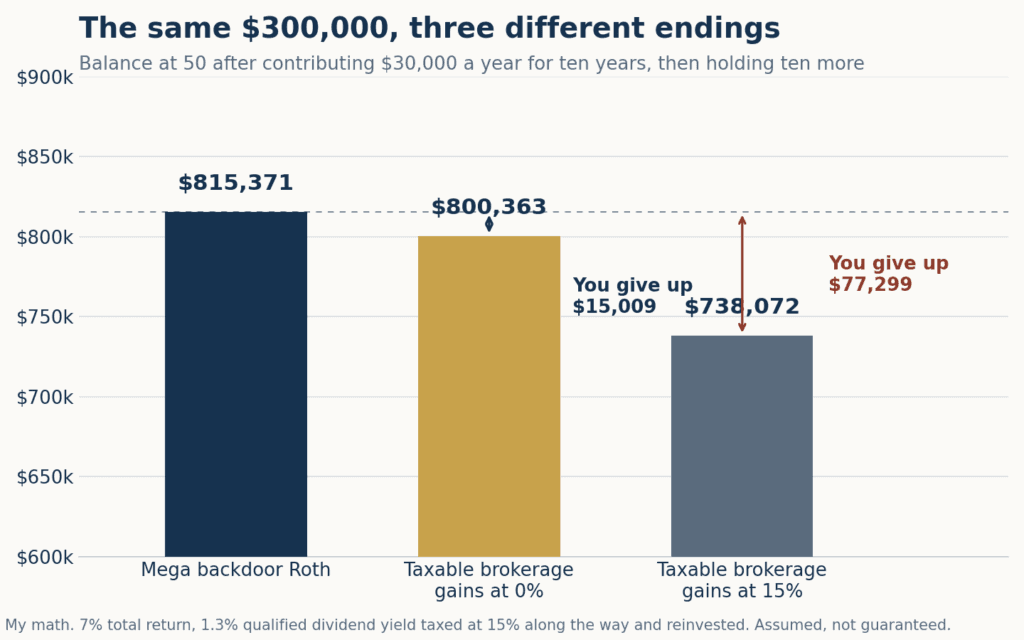
Look at the middle bar first, because that’s the one that surprised me.
If your gains come out at a 0% capital gains rate, the taxable brokerage lands $15,009 behind the Roth on $300,000 contributed. That’s 1.8%. Spread across twenty years it works out to roughly $750 a year, and every dollar of it is dividend tax drag. Taxes you pay each April on distributions you never asked for and immediately reinvested.
Seven hundred fifty dollars a year to keep every dollar reachable at any age for any reason. I’d pay that. I do pay that.
Now the third bar. Same money, same decade, gains coming out at 15% instead. The gap goes to $77,299. Nine and a half percent of the balance, gone, for the identical decision.
The premium holds its shape across return assumptions too. Run it anywhere from 5% to 10% and the 0% case stays between 1.4% and 2.2% of the balance while the 15% case runs 7.8% to 11.2%. The return assumption barely moves it. Your future tax bracket moves everything.
The mistake isn’t picking the wrong account. It’s never checking what the choice costs. That one is quiet and it compounds, which is true of most of the expensive ones.
The Access Rule Almost Everyone Gets Wrong
Go read the most popular forum threads on this question and you’ll find two confident camps. One says mega backdoor Roth money is locked until 59½ and early retirees should stay away. The other says pull the contributions anytime, no problem. A certified financial planner on one of those threads told a poster that withdrawals in their forties would likely face a 10% penalty even on contributions.
Both camps are wrong, and the correct answer depends on something neither of them asks about.
When you roll after tax 401(k) money out to a Roth IRA, the contributions arrive as basis. That money was already taxed on the way in, so it was never includible in your income when it converted. The 10% early distribution penalty and its five year clock attach to the portion of a conversion that was includible in income. Your basis wasn’t. It comes back out tax free and penalty free at any age.
Only the earnings sit behind the age gate. Those get taxed and penalized if you touch them before 59½, or before five years, whichever runs longer.
That matters more than any tax rate in this article, because it means the mega backdoor Roth is a bridge asset. Not entirely. But mostly, and for a long time. In the early years an account is nearly all basis, which means nearly all of it is reachable.
Converting Inside the Plan Is Not the Same Account
Here’s the fork, and it’s the whole reason page one of Google contradicts itself.
Some plans let you roll after tax money out to your own Roth IRA. Others only let you convert it inside the plan into a Roth 401(k). People say “mega backdoor Roth” for both. They don’t behave the same on the way out.
A Roth IRA lets you take contributions first, then conversions, then earnings, in that order, which is what makes the basis reachable. A Roth 401(k) doesn’t work that way. Schwab lays this out plainly. Inside a designated Roth account the IRS treats a nonqualified withdrawal as a proportional mix of contributions and earnings, so you can’t cherry pick the basis the way you can in an IRA.
So before any of this is a math question, it’s a plan document question. Two things to look for. Whether after tax contributions are allowed at all, and whether the plan permits an in service rollout to a Roth IRA rather than only an in plan conversion. Automatic rollout is the version you want, because doing it by hand every quarter is miserable enough that people quit.
I’ve never once called a benefits line to ask. I read the plan document. It’s twenty minutes and the answer is in there.
I used to justify skipping Roth space by pointing at the $7,500 IRA contribution limit and saying it was too small to fund a bridge. True for a regular Roth IRA. Completely irrelevant to this. A mega backdoor rollout moves money through the $72,000 annual additions limit under IRS Notice 2025-67, so after a $24,500 deferral there’s often something like $47,500 of room, minus your employer’s contributions. That’s six times the IRA cap, and it arrives as accessible basis. My reasoning was wrong. My answer survived for different reasons, which I’ll get to.
Why the Number Swings Five Times Over
Back to the $15,009 and the $77,299. The gap between them is one question. Do your capital gains come out at 0% or don’t they?
The 0% bracket is more generous than people think. For a married couple in 2026, IRS Revenue Procedure 2025-32 puts the ceiling at $98,900 of taxable income, and the standard deduction adds $32,200 on top. Call it $131,100 of gross income before a single dollar of long term gain gets taxed. I’ve written the full version of how a retired couple pulls six figures and owes nothing.
Then there’s the cool part. When you sell shares, only the gain is income. Your own basis comes back invisible. A taxable position built over twenty years of steady contributions is roughly half basis, so pulling $80,000 out of it realizes something like $41,500 of actual taxable gain, assuming you sell proportionally. Sell the wrong lots and that number can run closer to double. I broke down exactly why in how much of your taxable account is actually unrealized gains.
Against $131,100 of room. You could stack close to $90,000 of Roth conversions on top of that draw before your gains start getting taxed at all.
Which is the honest case for the taxable brokerage, and it’s stronger than the optimizer crowd admits. For a normal early retiree spending a normal amount, that account is close to tax free on the way out. Most of the theoretical Roth advantage never shows up.
So why not go all taxable? Because you’re making a promise about the year 2046 and you can’t keep it.
Spend more than you planned and gains push past the ceiling. Add a rental, a consulting gig, a spouse who keeps working, and ordinary income fills the bracket before your gains even get in line. Manage MAGI for an ACA subsidy and you’re rationing the same room three ways. Run a conversion ladder to drain the pretax pile and you’re rationing it four ways. Congress can move the 0% bracket whenever it wants. It has before.
Every one of those puts you in the third bar. That’s what you’re actually deciding. Not which account is better, but how confident you are about a tax bracket two decades from now, on a plan that hasn’t survived contact with reality yet.
I’m not that confident. Nobody should be.
Which One Gets Your Next Dollar
Here’s my order, and here’s why the split is the answer rather than a dodge.
| Order | Where the dollar goes | Why |
|---|---|---|
| 1 | 401(k) to the full employer match | Immediate guaranteed return. Nothing else competes. |
| 2 | HSA to the family maximum, if you have one | The only account with three tax advantages at once. |
| 3 | Split between the mega backdoor Roth and the taxable brokerage | You can’t price the premium without knowing your 2046 bracket, so buy both sides. |
| 4 | Whatever’s left, back into pretax 401(k) space | Only up to your conversion ceiling. Past it the deduction stops paying you. |
Weight the split by how close you are to quitting.
Ten or more years out, tilt toward the mega backdoor Roth. You’ve got time for basis to accumulate and time for five year clocks to expire before you need anything, and the compounding advantage has the longest runway it’ll ever have.
Inside five years, tilt toward the brokerage. Your remaining contributions won’t compound long enough for the Roth advantage to matter much, and short dated money wants to be reachable without paperwork. Size that bridge deliberately instead of hoping it’s enough.
My own line is a ceiling rather than a ratio. I want somewhere between 40% and 50% of my invested dollars sitting behind 59½ and no more. Above that I get uncomfortable, because the bridge has to carry the nineteen and a half years before the penalty wall lifts and I’d rather over-build it than find out at 46. Pick your own number and let it govern the split.
Where I’ve landed for myself, with no mega backdoor available at my current job, is the brokerage. I maxed pretax from about 24 to 30, hit my coast point, and cut to the match, and everything since has gone to the bridge. If a plan with a clean automatic rollout showed up tomorrow, I’d split. I’d still keep the brokerage larger, because I value being able to reach any dollar for any reason more than I value the last few percent, and now I know that preference costs me somewhere north of $750 a year rather than nothing. That’s a price I’m choosing to pay with my eyes open, which is different from the way I used to think about it.
Open your summary plan description this week and search it for the words “after tax.” Not Roth. After tax. Then check whether in service rollouts are allowed. Twenty minutes tells you whether this decision is even yours to make, and if it is, run your split through the early retirement calculator to see how it moves your date.
I had that door open for years and never checked.
Quick Answers
Should I fund a mega backdoor Roth or a taxable account first?
Neither, exclusively. Splitting beats picking a winner for almost everyone retiring early, because the mega backdoor Roth wins on lifetime tax and the taxable account wins on reachability before 59½, and you need both properties. Fund the taxable side until your bridge covers the years between your exit and 59½, then send everything above that into the mega backdoor Roth. The full dollar comparison is above, and the gap runs anywhere from $15,009 to $77,299 depending on assumptions.
Is a backdoor Roth versus a brokerage account the same comparison?
Same logic, much smaller stakes. A regular backdoor Roth moves $7,500 for 2026. The mega backdoor moves after tax 401(k) money and the ceiling is far higher, which is why the choice actually matters there. If you are weighing a plain backdoor Roth against a brokerage account, do the backdoor Roth and stop thinking about it. The amount is small enough that it will not strand your bridge.
The contributions, yes, if the money went to a Roth IRA. After tax basis was never includible in income when it converted, so the 10% penalty and its five year clock don’t reach it. Earnings are a different story and stay locked until 59½ or five years, whichever is longer. If your plan only offers an in plan conversion into a Roth 401(k), you lose that ordering and withdrawals come out proportionally instead.
Start with the $72,000 annual additions limit, subtract your $24,500 elective deferral and everything your employer puts in, and what’s left is your after tax room. For a lot of people that’s in the neighborhood of $40,000 to $47,500. Both figures come from IRS Notice 2025-67 and change every year.
On pure after tax math, yes, most of the time. How much better depends entirely on your future capital gains rate. On $30,000 a year for ten years the Roth advantage is about $15,000 if your gains come out at 0% and about $77,000 if they come out at 15%. That’s a wide enough range that funding both is a reasonable hedge rather than a fence sit.
Then the decision isn’t yours and the taxable brokerage is your answer. That’s most people. Roughly a third of Vanguard plans allow in plan Roth conversions, and after tax contributions are their own separate plan feature on top of that. Ask once, write down the answer, and stop rethinking it.
Take the full match first, always. After that it depends on whether your projected pretax balance clears your conversion ceiling. Under the ceiling, the deduction is still paying you and you should keep taking it. Over it, you’re accepting lockup for a spread that has already gone to zero, and after tax space is the better home for those dollars.
You found this one. There are ten more.
Quiet, slow, expensive, and almost always disguised as responsible behavior. Get the 10 Quiet Mistakes That Kill Your Early Retirement, free.
Every dollar figure in the chart comes from a year by year model I built and ran myself, not from a study, and the assumptions sit in the caption. A 7% total return and a 1.3% dividend yield are assumptions, not forecasts, and your real numbers will differ. Contribution limits and bracket thresholds are 2026 figures from IRS Notice 2025-67 and Revenue Procedure 2025-32, and both change annually. The free guide is free and puts you on my email list, where I also sell The Early Retirement Blueprint. No custodian, broker, or plan provider pays me anything. I’m an engineer building this for my own family, not a licensed advisor, so treat it as education rather than advice.