
By Antonio Hill
Here’s the ladder example with real numbers. A married couple retires at 40 spending $120,000 a year. They want to move traditional 401(k) money into a Roth so they can spend it decades before 59½. How much can they actually convert this year and keep their health insurance subsidy?
Thirty thousand dollars.
Not the $133,000 that fills their 12% bracket, which is what a lot of other articles or guides will point you toward. Thirty. Their own brokerage account ate the rest of the room before they converted a dime.
And once you see why, you run into the real problem. There are three main things worth optimizing during those bridge years, and you only get to keep two.
How the Ladder Works, Fast
You’re 40. You quit. Most of your money sits in a traditional 401(k) that you supposedly can’t touch until 59½ without handing over a 10% penalty. So you’ve got a 20 year gap to fund and a pile of money you’ve been told is off limits.
The ladder solves that. Each year you move a chunk from the traditional 401(k) or IRA into a Roth IRA. That handoff is a conversion, and you pay ordinary income tax on it in the year you do it. Then it sits. Five years later that exact chunk comes out of the Roth with no tax and no penalty, nowhere near 59½. Do it every year and you’ve built a staircase. Convert at 40, spend it at 45. Convert at 41, spend it at 46.
Two rules do the heavy lifting, and both come straight from IRS Publication 590-B.
The Five-Year Clock Starts January 1
Every conversion gets its own five year clock, and the clock starts January 1 of the year you convert. Not the day you clicked the button. Convert on December 20, 2026 and the IRS treats it as January 1, 2026, which means the money frees up January 1, 2031. You just turned a five year wait into roughly four real years by converting late in the year. Small thing, free money, take it.
You Only Move Principal, Never Earnings
The ladder pulls out converted principal, meaning the dollars you moved and already paid tax on. Roth earnings play by a stricter rule and stay locked until you’re 59½ with a five year old account. The IRS withdrawal order protects you here on purpose. Contributions come out first, then conversions oldest first, then earnings dead last. You’d have to drain every dollar of principal before you accidentally touched an earnings dollar.
That’s the mechanism. It’s also where the three levers of early retirement run in reverse. Time in the market becomes the years your portfolio has to survive, contributions become withdrawals, and the return lever is the one you’re trying to protect by leaving money invested inside the Roth while you spend down rungs that already seasoned. If the whole “locked until 59½” idea is new to you, start with my piece on getting to your money before 59½.
The Number Every Guide Gets Wrong
Now the part that made me rebuild my own plan.
Every guide tells you to size the conversion by filling your low tax brackets. For a married couple in 2026, the standard deduction is $32,200 and the 12% bracket runs to $100,800 of taxable income, so filling it means converting $133,000 gross and paying about $11,600. An 8.7% blended rate to defuse a pre-tax account that would otherwise get taxed at required minimum distribution time. On paper it’s beautiful.
Except that advice assumes the conversion is the only thing in your income. For an early retiree, it never is.
When you buy health insurance on the ACA marketplace, your subsidy depends on modified adjusted gross income. MAGI. And MAGI includes everything your portfolio throws off while you’re living on it. Dividends you never asked for. Capital gains from the shares you sold to buy groceries. Interest. The conversion goes on top of all of it, and the cliff does not care which bucket the income came from.
How about we run the numbers for our couple? They’ve got $1,000,000 in a taxable brokerage funding the bridge years. At the 1.1% dividend yield a total US market index fund was paying in July 2026, that’s $11,000 landing in their lap whether they want it or not. They need $120,000 to live, so they sell $109,000 of shares to cover the rest.
Only the Gain Counts, Not Your Own Money Coming Back
Here’s the part that helps you a lot, and not many explain it properly. When you sell $109,000 of shares, the IRS does not treat $109,000 as income. Most of that money is your own principal coming home. Only the profit counts.
Let’s assume a 40% gain, meaning 40 cents of every dollar you sell is profit and 60 cents is the money you originally put in. Sell $109,000 and only $43,600 shows up in MAGI. The other $65,400 is invisible. That gap between what you spend and what you report is a huge reason early retirement tax planning works at all.
But it still adds up. Dividends of $11,000 plus realized gains of $43,600 puts $54,600 of MAGI on the board before this couple converts a single dollar.
The 2026 subsidy cliff for a two person household sits at roughly $84,600, which is the same threshold I broke down in the $84,600 Cliff piece. Subtract what the brokerage already used and you get $30,000 of conversion room. That’s the whole ladder rung. One dollar past it and the entire premium credit vanishes, with no repayment cap to soften the landing. GGs.
This is the mistake I want you to take from the whole article. Your conversion size is not a tax bracket decision. It’s whatever the cliff leaves you after your own portfolio takes its cut. If you want the other nine problems like this one, the ones sitting one layer under the obvious advice, I put them in a free guide.
Pick Two. You Can’t Optimize All Three
Now the real trap, and the reason I’ve been struggling with this for months.
There are three things worth having during the bridge years: an ACA premium subsidy, which for a couple in their forties runs into five figures a year. The 0% long term capital gains bracket, which lets you sell appreciated shares and pay nothing, and which for a married couple in 2026 holds until taxable income crosses $98,900. And a Roth conversion ladder big enough to actually fund your retirement instead of decorating it.
You cannot have all three. Watch.
| Strategy | Conversion | Federal tax | MAGI | ACA subsidy | 0% cap gains |
|---|---|---|---|---|---|
| A. Convert to the cliff | $30,000 | $0 | $84,600 | Kept | Kept |
| B. Convert to the 0% ceiling | $76,500 | $4,820 | $131,100 | Gone | Kept |
| C. Fill the 12% bracket | $133,000 | $19,790 | $187,600 | Gone | Gone |
Married couple, 2026 figures. Assumes $120,000 of spending, a $1,000,000 taxable brokerage at a 1.1% dividend yield, and a 40% gain on shares sold. Standard deduction $32,200, 12% bracket top $100,800 of taxable income, 0% capital gains ceiling $98,900 of taxable income, all per IRS Rev. Proc. 2025-32. ACA cliff $84,600 per the 2025 HHS poverty guidelines governing 2026 coverage. Your numbers move with household size, spending, and basis.
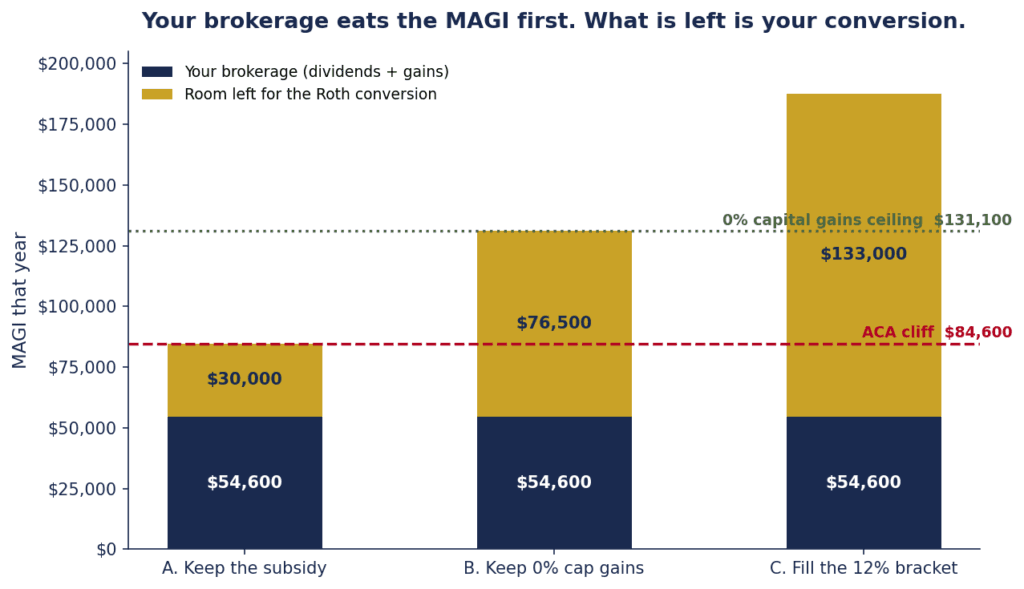
Strategy A is free. Zero federal tax, because $30,000 of conversion gets swallowed whole by the $32,200 standard deduction before a bracket ever touches it. Keep the subsidy, keep the 0% gains, pay nothing. It looks like the obvious winner right up until you ask what a $30,000 rung actually does for you.
It covers 25% of one year’s spending. You’d be building a ladder that never carries the load, while pulling $109,000 a year from taxable, which throws off more gains, which eats more headroom next year. The thing feeds on itself.
Strategy C is the one every guide recommends, and it costs $19,790 in tax while torching a five figure subsidy. Worse, converting that much pushes taxable income past $98,900, so gains that were free now get taxed at 15%. The advice designed to save you money triggers two separate penalties at once.
Strategy B is the honest middle. Give up the subsidy on purpose, keep the 0% capital gains bracket, convert $76,500 for $4,820. Note where the MAGI lands. $131,100 is the same ceiling from the zero federal tax piece, though the composition differs here because part of this income is ordinary.
I’ll be straight with you. I want all three. I’ve spent a decade optimizing everything I can measure, I hit Coast FIRE years ago, and my 401(k) is on track to be large enough that required minimum distributions at 75 under SECURE 2.0 will shove me into a bracket I never chose. Conversions are the fix. The subsidy is worth real money. The 0% gains bracket is free. And the math says pick two. That bothers me more than I’d like to admit, and I’d rather tell you that than pretend I found a clever workaround nobody else noticed.
Kitces.com has made this point for years in a different context. Tax brackets, as their analysis puts it, “don’t account for the add-on effects of Roth conversions.” The bracket is the sticker price. It was never the bill.
How to Choose Your Two
The answer depends almost entirely on one number, which is how much you spend. Every extra dollar of spending forces another share sale, which realizes more gain, which takes another bite out of your conversion room.
| Annual spending | Gain realized | Total MAGI from the brokerage | Conversion room under the cliff |
|---|---|---|---|
| $60,000 | $19,600 | $30,600 | $54,000 |
| $80,000 | $27,600 | $38,600 | $46,000 |
| $100,000 | $35,600 | $46,600 | $38,000 |
| $120,000 | $43,600 | $54,600 | $30,000 |
| $150,000 | $55,600 | $66,600 | $18,000 |
Every $20,000 you add to your spending costs you $8,000 of conversion room. That’s your gain rate doing the work, and it’s why a leaner retirement makes the ladder easier and a richer one makes it nearly impossible. That gain rate isn’t fixed, either. Lowering it before you quit is usually the wrong move, but the free ways to lower it (specific identification, killing DRIP in your last working year) are worth doing regardless, since every point of gain fraction you shave off buys back conversion room in every strategy above.
When Keeping the Subsidy Wins
Spend under about $80,000 and strategy A stops being a compromise. You’ve got $46,000 of room, the conversion is close to free, the subsidy stays, and the rung covers more than half a year of expenses. Harry Sit at The Finance Buff ran the marginal math on a subsidized couple and found an extra $10,000 of income carried an effective rate of “29%, not 12%” once the shrinking credit got counted. When the subsidy is that expensive to lose, protect it and convert what fits.
When You Should Let the Subsidy Go
Two situations flip it. If your spending sits above roughly $120,000, the subsidy is strangling a ladder you actually need, and paying $4,820 to move $76,500 is the better trade over a 20 year bridge.
The second is simpler. If somebody in the household has employer coverage, the ACA cliff doesn’t exist that year, so convert aggressively while the window is open. My wife plans to keep working for about five years after I stop, and if her at-that-time job carries the health insurance, those are the years I’ll convert hard. I think it’s worth being clear about something here, though. I will not stop working until we have enough for both of us to quit completely. None of my calculations ever include her income during those years, and since we have no clue what the nature of her work or income will be, I couldn’t accurately include it if I wanted to.
Run your own household through KFF’s subsidy calculator before you commit to a number, and check what your state takes from the conversion while you are at it, because the federal bill is not the only one. Your premium depends on your age and your zip code, and a $22,000 subsidy in an expensive market changes the answer that a $9,000 subsidy would not.
Common Mistakes and What to Do Instead
Deciding your withdrawal plan AFTER you’ve already retired. This one is fatal and it happens constantly. Every option above depends on account structure you had to build years earlier. A taxable brokerage big enough to fund five years before the first rung matures. A traditional balance worth converting. A basis low enough that selling doesn’t blow up your MAGI. Show up at 40 planning to figure it out and you’ll find your money in the wrong accounts with no fast way to fix it. The planning happens a decade early or it doesn’t happen.
Thinking a withdrawal rate is a plan. It isn’t. If you’ve picked a 4% number and never touched conversion timing or the ACA interaction, you have a spending assumption, not a retirement plan. Taxes are most of the actual work.
Forgetting that dividends show up uninvited. You control when you sell. You don’t control when a fund distributes. That $11,000 arrives every year whether it’s convenient or not, and it’s the first thing eating your headroom. If you’re still accumulating, this is an argument for holding your least tax efficient funds inside tax advantaged accounts, and for paying attention to basis now rather than discovering it at 40. The same discipline that got the portfolio to seven figures is what makes it spendable later.
Do this today. Open your brokerage, find your cost basis and your unrealized gain, and divide the gain by the total value. That percentage is the single number that determines how big your ladder can ever be. Then subtract your projected dividends and realized gains from your household’s cliff, and whatever’s left is your real conversion number. Not the 12% bracket. Not what a guide told you. What’s left.
Get the 10 Quiet Mistakes That Kill Your Early Retirement
The MAGI trap in this article is exactly the kind of one layer down problem that wrecks otherwise solid plans. I put the ten I see most often in one free guide. Real numbers for the things that actually move your timeline.
FAQ
How much can I convert to a Roth and keep my ACA subsidy?
Take your household’s 400% FPL threshold, roughly $84,600 for a couple in 2026, and subtract everything else in your MAGI. That means dividends, interest, and the gain portion of any shares you sell to live on. Whatever remains is your conversion room. For a couple spending $120,000 from a $1,000,000 brokerage, that works out to about $30,000.
Do capital gains from my brokerage count toward the ACA cliff?
Yes, but only the gain, never the principal you get back. Sell $109,000 of shares with a 40% gain and $43,600 enters MAGI while the other $65,400 stays invisible. Qualified dividends count too, even though they may be taxed at 0%.
Why is my conversion so much smaller than the guides say?
Because those guides size the conversion against your tax bracket and assume no other income. An early retiree living off a taxable account always has other income. Your brokerage fills part of the MAGI budget before you convert anything, and the conversion only gets what’s left.
Is it ever worth going over the ACA cliff on purpose?
Yes. If your spending is high enough that subsidy protection leaves you a rung too small to fund your retirement, or if a spouse’s employer plan covers you that year, converting past the cliff is the better long term trade. Compare your actual subsidy value against the tax on the larger conversion before deciding.
What funds my spending during the first five years?
Your taxable brokerage and cash, which is why the account structure has to exist years before you retire. The first rung isn’t available until five calendar years after your first conversion. If you can’t wait, compare the 72(t).
Why convert at all if required minimum distributions are decades away?
Two reasons. It’s how you reach 401(k) money before 59½ without the penalty, and it shrinks the pre-tax balance that drives future RMDs. Anyone born in 1960 or later has an RMD age of 75 under SECURE 2.0, and a large enough balance by then forces withdrawals at a rate that sets your bracket for you. The size that balance can be and still get cleared cheaply has a name and a number, and I worked it out in how much pretax is too much.
I write about my own strategy and my own plan. The free guide linked above is genuinely free, and it puts you on my email list where I also sell The Early Retirement Blueprint. I am not compensated by any custodian, broker, or insurer mentioned here. This is educational content, not personalized tax or investment advice. Tax rules change and your situation is not mine, so confirm anything here against current IRS guidance or a professional before acting on it.